Ebike Phone Mounts
The thing most buyers find out too late is that the handlebar is a hostile place for a camera module. Here is the mechanism, the fix, and the case for not mounting a phone at all.
On this page
A phone mount looks like the simplest accessory on a bike. A clamp, a cradle, done. The reason it deserves a full guide is that the failure mode nobody warns you about is not the phone falling off. It is the phone still being attached, working fine, and taking blurry photos for the rest of its life.
Modern phone cameras use optical image stabilisation, which suspends a lens element on a tiny spring and magnet assembly and moves it in real time to cancel out shake. Closed-loop autofocus works the same way, with magnets and position sensors moving the lens. Those are precision mechanical systems with moving parts measured in fractions of a millimetre, and they are designed for the vibration a hand produces, not for hours of continuous input from a rigid aluminium handlebar.
Apple has published guidance on this specifically, advising against attaching an iPhone to motorcycles with high-power engines because sustained high-amplitude vibration in certain frequency ranges can degrade those systems. A bicycle is a milder environment than a motorcycle. It is not as mild as people assume once the bike weighs 60 lb, has no suspension, and holds 20 to 28 mph over broken tarmac.
The camera problem, in more detail
The damage is cumulative and quiet. It does not announce itself with a crack or an error message. What people report is that the main camera stops focusing reliably, that photos are soft when the wide-angle lens on the same phone is fine, or that a faint rattle appears when the phone is shaken. By the time it is obvious, the ride that caused it was months ago.
Two properties of the vibration matter. Amplitude is how hard the bar is shaking, which on a bike is driven by tyre pressure, tyre volume, surface roughness and whether the frame or fork has any compliance. Frequency is how fast, which on a bicycle spans a broad band and includes the high-frequency buzz that a stiff aluminium frame transmits particularly well. Rigid mounts pass both straight through, and a hard plastic cradle bolted to a hard aluminium clamp is about as rigid a path as you could design.
Ebikes sit at the wrong end of every one of those variables. They are built heavy and stiff to carry motor torque and rider weight. Many have no suspension at all. They run higher speeds for longer, so the exposure time per ride is greater. And a large share of them are ridden as daily transport, meaning the phone is on that bar every single day rather than for a weekend ride. Tyre choice makes a real difference here, which is one of the less obvious arguments in our guide to ebike tyres and wheels: a wider tyre run at a lower pressure is doing genuine damping work.
What a damped mount actually does
A vibration-damping mount inserts a compliant element into the load path. In most designs it is a moulded elastomer disc or a set of rubber bushings sitting between the handlebar clamp and the phone cradle. Two things happen. The elastomer converts some vibration energy into heat rather than passing it along, and the added compliance shifts the natural frequency of the assembly away from the band where the bar is putting energy in.
The main aftermarket versions come from the brands that sell adhesive-puck systems, Quad Lock being the best known, with similar parts from SP Connect and Peak Design. Their dampers are sold as separate spacers that fit between their own mount and cradle, typically for fifteen to thirty dollars. Some clamp cradles now build a rubber layer into the arm assembly instead.
Be realistic about what this buys. A damper reduces the energy reaching the phone; it does not isolate it. It also introduces a small amount of wobble, so the phone bounces visibly over big hits, which looks alarming and is exactly the compliance doing its job. If your phone is old, cheap, or one you would replace without much regret, you can skip it. If it is a current flagship with a camera system worth several hundred dollars on its own, a damper is the least expensive risk reduction available.
The three mount types
Clamp cradle
Spring-loaded arms grip the phone at the corners or the edges. Universal, cheap, and works with any phone in any case within the stated size range. The good ones use four corner arms plus a bottom shelf and a locking mechanism that stops the arms releasing. The bad ones use two side arms and spring tension alone, which is the design that lets a phone launch over a pothole.
Two specific things to check. First, whether the arms sit over your volume or side buttons, because a cradle that presses the volume-down button repeatedly over rough ground will trigger screenshots, camera captures, or in some configurations an emergency call. Second, whether the arms block the charging port, which they often do on the bottom shelf design.
Adhesive puck and twist lock
A hard plastic puck attaches to the phone, either through a dedicated case or with a strong adhesive pad, and twists into a matching receiver on the bar. Quad Lock is the category leader and the pattern is widely copied. This is the most secure system by a clear margin, because the connection is a mechanical interlock rather than a friction grip, and it is the fastest to use once fitted.
The trade-offs are real. You are committed to a case or to a permanent puck on the back of your phone, which interferes with wireless charging on most designs. The system is phone-model specific, so a new phone means a new case. And it costs three to five times what a clamp cradle costs. For someone riding daily who navigates constantly, it is the one worth paying for. For occasional use it is overkill.
Strap and pouch
Silicone straps that stretch around the phone and hook onto the bar, or a fabric pouch with a clear window that straps to the bar or top tube. Cheapest, most universal, and least secure. Silicone perishes under UV and eventually snaps without warning, usually in the second or third season. The pouch version is the choice if you want basic weather protection and do not mind reduced touch response.
Where a phone on the bars makes sense
- Short urban rides where you already know most of the route
- Following a route you looked up before leaving
- Errands with several stops and address lookups
- Delivery work, where the phone is the job
- Anywhere you would otherwise stop and pull it out of a pocket
Where it does not
- All-day rides, where battery becomes the constraint
- Bright direct sun, where a phone screen loses to a transflective display
- Rough surfaces, unless the mount is damped
- Hot weather with the screen at full brightness and GPS running
- Any situation where dropping it would ruin the day
Retention on a bike that hits potholes
Retention failures split into three categories, and each has a different fix.
The phone leaves the cradle. Almost always a two-arm spring design meeting a sharp-edged pothole. The fix is a cradle with four corner arms and a positive lock, or a puck system. Many cradles ship with a thin silicone safety net that stretches over the phone corners, and it looks cheap and it works. Use it.
The cradle rotates on the bar. The clamp was tightened by hand on a smooth bar and vibration walked it round until the phone points at the ground. The fix is a rubber shim inside the clamp, correct torque on the bolt, and a check after the first hundred miles. This is the same failure that affects every bar-mounted accessory, which is why it appears in our maintenance guide as a routine check.
The ball joint slips. Many mounts use a ball-and-socket between clamp and cradle for angle adjustment, and a plastic socket loses its grip over time. There is no good fix beyond replacing the mount, so prefer designs where the angle is set by a clamped hinge rather than friction.
There is also the theft question, and it has a short answer: never leave a phone on the bar. A quick-release cradle is a quick release for anyone walking past. Take the phone with you and leave the mount, the same way you would treat a light. Everything else about leaving a bike unattended is in ebike locks and theft prevention.
Water, screens and the port you forgot about
Most current phones are rated IP67 or IP68, which comfortably covers rain. The mount does not need a waterproof rating because it is a plastic clamp. So the honest position is that riding in the rain with a bare phone in a cradle is usually fine, and the hard cases sold on waterproofing solve a problem most riders no longer have.
Two things do go wrong. The first is that capacitive touchscreens behave badly when wet. Water on the glass creates phantom touches, the screen registers taps you did not make, and swipes stop working. Nothing about the mount changes this; what changes it is wiping the screen or switching the phone to a mode that does not need input.
The second is the charging port. Ebikes often have a USB output from the controller, and running a cable to the phone while riding through rain pulls water toward a port that is only sealed when nothing is plugged into it. Corrosion in a USB-C port is a slow, annoying and expensive failure. If you charge on the bike, route the cable so it loops below the port so water runs off rather than down, and unplug in heavy rain. More on where water actually gets into an electric bike is in riding an ebike in the rain.
Cold is a separate problem. Lithium cells lose usable capacity below freezing, so a phone that navigates for three hours in summer may manage well under two in winter, and it can shut down abruptly at a low but non-zero indicated charge. That is the same chemistry that governs your bike's range, as our winter riding guide explains. A phone in a cradle also sits in full airflow, which is the worst place for it.
The honest case for a bike computer instead
Almost everyone buying a phone mount for navigation would be better served by a dedicated bike computer, and the reasons are unglamorous.
Battery. Continuous GPS plus a bright screen is one of the heaviest loads you can put on a phone. Expect to lose a substantial share of a full charge in a couple of hours of navigation, more in direct sun where the screen runs at maximum brightness, and more again if the phone is warm enough to throttle. A bike computer runs all day, and many run for multiple days.
Sun readability. Phone screens are emissive: they fight the sun by getting brighter, which costs battery and generates heat. Most bike computers use a transflective display that reflects ambient light, so the brighter the sun the more readable the screen gets. On a bright day this difference is not subtle.
Durability and replacement cost. A bike computer is designed for rain, vibration and being dropped on tarmac. It is also a fraction of the cost to replace, and it does not take your contacts, payment cards and photographs with it when it goes.
Heat. A phone in a black case, in direct sun, running GPS and charging simultaneously, will get hot enough to dim its screen and slow down. That is the exact moment you need to read it.
The phone still wins for looking up an address you did not plan, reading a full map at a stop, calling someone, and any ride where two hours of battery is plenty. For touring and bikepacking, where charging is the whole planning constraint, a computer is close to essential and the phone stays in a pocket. For delivery riding, the phone is the job and the answer is a damped mount plus a wired charge feed.
Mounts worth looking at

Lamicall Lockable Bike Phone Holder
- Four-point cradle with a locking mechanism rather than spring tension alone
- One-hand operation to insert and release
- Handlebar clamp sized for standard bars, shims included
- Sold for both bicycle and motorcycle use
A lock rather than pure spring tension is the feature that separates a cradle that keeps the phone from one that eventually does not, and one-hand operation is what makes a mount get used rather than resented. Check your phone measured in its case against the stated width range, and check where the arms land relative to your side buttons before you commit to it. If you want damping, plan to add a rubber spacer or accept lower tyre pressures as your compliance.
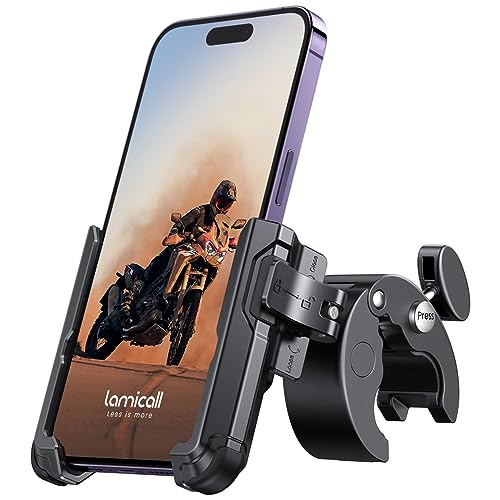
Lamicall 1s Lock Bike Phone Mount
- Push-to-lock action designed for a single motion
- Handlebar clamp with rubber shims for varying bar sizes
- Adjustable viewing angle
- Same construction family as the lockable holder
The argument for this one is behavioural rather than technical. A mount that takes five seconds and two hands gets skipped at the third stop of a delivery shift or a multi-errand ride, and a phone in a jacket pocket is a phone you pull out at traffic lights. If your riding involves getting on and off constantly, speed of operation is the specification that matters most.

LISEN Bike Phone Holder
- Tool-light installation, aimed at fitting in a couple of minutes
- Sold specifically for ebike and bicycle handlebars
- Compact clamp for a crowded cockpit
- Under ten dollars at the price we sourced
Sensible if you want to find out whether you will use a phone on the bars at all before spending more. At this price expect the plastic and the pivot to be the weak points, and expect no vibration damping whatsoever. Treat it as a trial rather than a long-term fitting, and if you find you use it every day, upgrade to something with a lock and a damper.

amzluv Bike Phone Holder Mount
- Basic secure handlebar cradle for bike and motorcycle bars
- Fits common phone sizes
- Minimal parts, so little to fail
- The lowest-cost way to stop riding with a phone in your hand
There is a genuine safety argument for the cheapest workable mount, which is that any mount is better than holding a phone or glancing at one in a pocket while moving. Just be clear about what you are not getting: no damping, no lock, and a plastic pivot that will loosen. Add the silicone safety net if one is included, and do not put a flagship phone in it for daily use.
| Mount | Retention | Best for | Price |
|---|---|---|---|
| Lamicall Lockable | Locking four-point cradle | Daily riding, larger phones | $18.99 |
| Lamicall 1s Lock | Push-to-lock | Constant stops | $21.99 |
| LISEN Holder | Spring arms | Trying a mount cheaply | $9.99 |
| amzluv Mount | Spring arms | Lowest cost | $6.99 |
| Puck and twist systems | Mechanical interlock | Heavy daily use, damper available | $60 and up |
Swipe sideways to see all columns →
Fitting it, and the habits that go with it
Measure the bar before you order. The grip section on most bars is 22.2 mm and the section near the stem is 31.8 mm or 35 mm, and a clamp rated to 32 mm will not close around a 35 mm bar. Then look at what is already there. An ebike cockpit typically carries brake levers, a display, a throttle, shifters and often a light, and the space left in the middle is smaller than you think. If turn signal switches are also in the plan, read ebike lights and turn signals before you allocate the real estate.
Position matters for a reason that has nothing to do with vibration. A phone mounted high and central sits in your line of sight to the road ahead, which is convenient and is also exactly where you want to be looking at traffic. Mounting slightly lower and offset means you glance down deliberately rather than reading it continuously, and reading a screen continuously at 22 mph is the actual hazard. The relevant point about ebike classes here is that the higher assist classes make that hazard worse, not that the rules address it.
Three habits worth building. Set the route before you move, so you are following a line rather than typing at junctions. Use audio directions through one earbud or a speaker where legal, so you can navigate with the screen off and save both battery and attention. And take the phone with you every time you leave the bike, without exception.
If you are still assembling the rest of the cockpit, our roundup of ebike parts and accessories worth buying puts a phone mount in order against everything else competing for that handlebar, and best commuter electric bikes covers the bikes that arrive with the useful parts already fitted.