Ebike Panniers and Bags: Pick by Load, Not by Looks
Four bag types, four different jobs, and a lot of people buying the wrong one. The sorting rule is what you carry and where the weight ends up sitting.
On this page
Bike bag shopping goes wrong in a predictable way. Someone wants to carry a laptop and a change of clothes, searches for saddle bags, and ends up looking at a 1 litre wedge designed to hold a spare tube. Or they want to carry tools and end up with a 20 litre handlebar roll flopping around on the front of a heavy bike.
The categories have names that do not describe what they do, so here is the version that does. Panniers carry loads. Saddle bags carry repairs. Frame bags carry dense small things in the best possible place. Handlebar bags carry the things you want to reach without stopping, and pay for that convenience in handling.
Everything below sorts by those jobs, then deals with the two questions that actually decide whether a bag is any good: whether it stays dry, and whether it stays put.
Sort bags by where the weight sits
A loaded bike handles according to where mass sits relative to two things: the steering axis and the ground. Weight close to the ground lowers the centre of mass, so the bike leans less eagerly and feels planted. Weight far from the steering axis, especially ahead of it and high up, adds inertia to the steering and makes the front end feel vague at low speed.
That gives a clean ranking. Frame bags sit lowest and most central, which is why bikepackers put their heaviest items there. Panniers sit low but outboard and behind, which is nearly as good and holds far more. Saddle bags are small enough that position barely matters. Handlebar bags sit high, forward and directly on the steering assembly, which is the worst combination available, and it is exactly the same problem covered in our guide to ebike baskets.
Ebikes amplify all of it because they start heavy. A 60 lb bike with 25 lb of cargo behaves differently from a 28 lb bike with the same 25 lb, and not just because the total is higher: the ebike has more of its own mass low down in the battery and motor, so added weight up high is a bigger proportional change to the balance than it looks.
| Bag type | Typical capacity | Effect on handling | Best for |
|---|---|---|---|
| Rear panniers, pair | 25 to 50 L | Small | Commuting, shopping, everything |
| Rack trunk bag | 8 to 20 L | Small, sits higher than panniers | Daily carry without side bags |
| Frame bag | 2 to 8 L | Least of any | Tools, lock, dense items |
| Saddle bag | 0.5 to 2 L | None | Tube, levers, multitool |
| Handlebar bag | 3 to 10 L | Largest | Phone, snacks, camera |
Swipe sideways to see all columns →
Panniers: the answer for almost everyone
A pannier hangs off the side of a rear rack on two hooks at the top and a lower anchor that stops it swinging. A pair gives you 25 to 50 litres, which is a week of shopping or a laptop plus gym kit plus lunch with room left. The weight ends up roughly level with the axle and outside the wheel, which is close to the ideal place to put it on a bike that already carries its motor low at the back.
Panniers come in three broad constructions, and the differences are real.
Roll-top single compartment
A tube of coated fabric with welded or taped seams and a roll closure. Genuinely waterproof, simple, and the design that touring cyclists have used for decades. The compromise is organisation: one big hole, no pockets, and finding your keys means unrolling everything. Roll it three full turns before clipping or it will leak, which is the single most common user error with these bags.
Zippered panel loaders
Open like a suitcase, with pockets, dividers and often a laptop sleeve. Much better to live with day to day. Zips are the weak point for water: a coated zip resists spray but is not a seal, and water finds the corners where the zip tape ends. Most of these ship with a pull-out rain cover, which tells you what the manufacturer thinks of the zip.
Convertible pannier-backpacks
Hooks fold away and shoulder straps deploy, so the bag comes off the bike and onto your back. Excellent if your commute ends with a walk or a train, and the compromise is that the harness adds bulk and the hook mechanism is more complex, which is more to rattle and more to break. If you park the bike and walk on, the extra cost is easy to justify.
Hard-shell trunk and pannier boxes
Rigid cases that clamp to the rack. They protect contents from crushing, they are usually lockable, and they shed water well. They are also heavier, fixed in shape, and less forgiving about rack width. Popular on ebikes because the bikes are heavy enough that a couple of extra pounds of case is not the issue it would be on a road bike.
Saddle bags and handlebar bags: the small stuff
Saddle bags are a tool kit, not luggage
This is the thing most search traffic gets wrong. A saddle bag straps under the saddle rails and to the seatpost, and its correct contents are a spare tube in your exact size, two or three tyre levers, a multitool with the hex sizes your bike uses, a patch kit and a couple of zip ties. That is 0.5 to 1 litre.
Go bigger and physics pushes back. The bag hangs off two straps in the most flexible part of the bike, so a heavy saddle bag pendulums under you, wears at the strap contact points, and on a dropper or suspension post can foul the movement. It also sits directly in the rear tyre spray, which is why saddle bag contents get filthy on any bike without a rear fender. On an ebike specifically, check clearance to the rear tyre when the suspension compresses fully, because a bag that clears while parked can rub under load.
There is one ebike-specific item worth adding to that kit: your motor cable connector spanner if the bike uses one, and a photograph on your phone of the rear axle nut torque figure. A hub motor wheel is not a wheel you can swap by feel at the roadside, which is one of several reasons our guide to ebike maintenance and repair argues for fixing punctures at home rather than on the verge.
Handlebar bags are convenient and destabilising
A handlebar bag puts your phone, wallet, snacks and camera where you can reach them, and every ounce of that sits high, forward of the steering axis and rotating with the bars. Under about 3 lb it is unnoticeable. Above about 5 lb it produces the same low-speed weave that a loaded front basket does, and on a 65 lb ebike with a wide bar that weave is slow and lazy rather than twitchy, which somehow makes it worse.
They also compete for the most contested real estate on an ebike. A centre-mounted display, a throttle, a remote pad, a bell and a phone mount already fill the bar. Measure the clear space each side of the stem before you order.
Frame bags and the ebike battery problem
A frame bag fills the main triangle, strapping to the top tube, downtube and seat tube. Mechanically it is the best place on a bicycle to carry weight: low, central, between the wheels, and completely outside the steering assembly. You can put a heavy lock and a full tool kit in one and feel almost nothing.
On an ebike, the triangle is usually already occupied. A downtube-mounted pack takes the lower half of it. An integrated pack takes the downtube itself and leaves an awkward shape. Bikes with the battery on the rear rack or inside a mid-drive area free the triangle up, but they are the minority. The result is that full frame bags mostly do not fit ebikes, and the sizes that do are half-frame wedges under the top tube and small top-tube bags behind the stem.
Two things to check before you order one. First, the actual open dimensions with the battery in place, measured with a tape rather than estimated. Second, whether the straps will sit over the battery mount, the charge port cover or the cable runs, because a strap tightened across a charge port is how the port cover gets broken and how water gets in. If you want the port to keep working, route around it. Where water actually enters an ebike is covered in riding an ebike in the rain.
Waterproofing, honestly
Three phrases appear on bag listings, and they mean three different things.
- Waterproof, roll-top, welded seams. The fabric is coated so water cannot pass through it, the seams are heat welded rather than stitched so there are no needle holes, and the roll closure creates a labyrinth seal. This genuinely keeps rain out. It is also the only construction that survives standing spray off a wet road for an hour.
- Water resistant with a rain cover. The fabric sheds light rain, the stitching does not, and the supplied cover pulls over the top. Covers work against falling rain and fail against road spray, which arrives from below where the cover does not reach. Fine for occasional showers, not for a wet commute.
- Water repellent coating. A surface treatment that makes water bead. It wears off, it does nothing for seams, and it is a marketing term more than a specification.
The practical middle ground most people land on: a roll-top for the commute where getting a laptop wet is expensive, and a cheaper zippered bag with a rain cover for shopping, where a wet bag of vegetables is not a disaster. Put anything that must stay dry into a dry bag inside whatever pannier you own, which costs a few dollars and removes the question entirely.
Bags worth looking at

KEMIMOTO 34L Rear Rack Pannier Set
- 34 L across the pair, which covers a full shop
- Supplied rain cover, so treat the fabric as water resistant not sealed
- Rear rack mounting, weight low and beside the axle
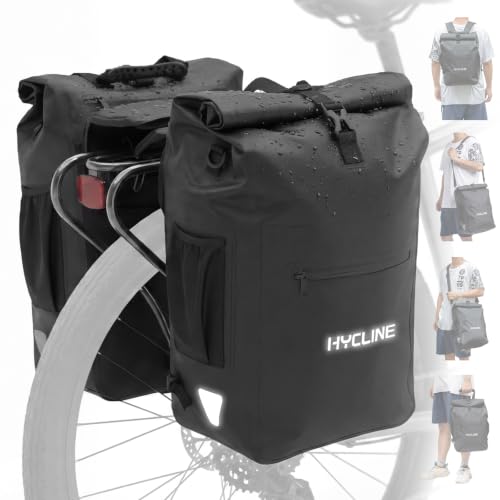
Hycline 28L Pannier and Backpack
- Converts between rack pannier and backpack, for commutes that end on foot
- 28 L, which is laptop plus kit plus lunch
- The harness adds bulk on the bike, which is the price of the conversion

NDakter 35L Expandable Rear Rack Panniers
- 35 L expandable, double bag over the rack platform
- Cheapest route to real carrying capacity on a bike you already own
- Expandable sections are the first place water gets in, so pack accordingly
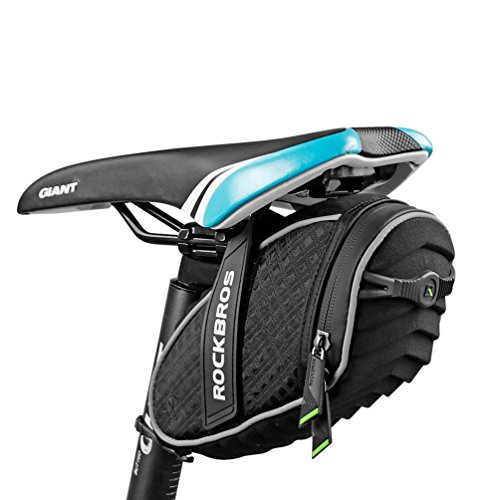
ROCKBROS Under-Seat Saddle Bag with Hard Shell
- Semi-rigid shell, so it holds shape instead of sagging into the tyre
- Sized for a tube, levers and a multitool, which is the correct job
- Strap mounting to rails and post, no rack needed

SILCA Mattone 0.5L Saddle Bag
- 0.5 L, deliberately small, with a BOA dial closure instead of a strap
- The dial is the point: it tightens evenly and does not creep loose
- Costs more than the bag category usually does, and lasts accordingly
Fitting: rattle, heel clearance and the rack limit
The rack rating is the real ceiling
Panniers themselves almost never fail. Racks do. Most ebike rear racks carry a rating between 25 and 55 lb, printed on the rack or buried in the manual, and that figure covers everything on it: both panniers, a trunk bag, a basket, all of it. Exceeding it does not usually produce a dramatic failure. It produces cracked welds at the strut joints and bolts that will not stay tight, discovered months later.
Frame-mounted racks handle load better than seatpost-clamp racks by a wide margin, and if your ebike has no rack eyelets, a seatpost rack is a 20 to 25 lb device at most, whatever it claims. There is more on rack construction and the ratings that matter in ebike racks and carriers.
Heel clearance is the fit problem nobody checks
Panniers hang forward of the rack rear, and your heel swings back at the bottom of the pedal stroke. If the gap is too small your heel clips the bag every revolution, which is maddening within a mile. Ebikes make it worse for a structural reason: many have short chainstays to keep the wheelbase manageable despite a large rear hub motor, and shorter chainstays mean the rack sits closer to the pedals.
The fixes, in order of preference: slide the pannier hooks rearward on the rack rail, which is what the adjustable hook positions are for; choose a bag with a tapered lower front corner; or move to a rack with a longer rear extension. Check clearance with the bag loaded, since a full bag bulges forward.
Rattle
Rattle comes from the lower anchor, not the hooks. The top hooks carry the weight; the lower hook or bungee stops the bag rotating outwards. If that anchor is loose or badly positioned, the bag swings a few millimetres on every bump and the hooks knock against the rack rail. Adjust the lower anchor until the bag cannot move by hand, and if the hooks themselves are the noise, most systems accept a rubber insert or a strip of old inner tube around the rail.
Panniers over a backpack
- The bike carries the weight, not your spine
- No sweaty back on a warm commute
- Far more capacity than you would carry on your shoulders
- Weight sits low, so handling barely changes
What panniers cost you
- Wider bike, which matters in a bike lane full of parked cars
- Two bags to unclip every time you park
- Needs a rack, and a rack needs eyelets
- Heel clearance issues on short chainstay frames
How to choose
- Name the heaviest, most awkward thing you carry weekly. That single item decides the category. A laptop and clothes means panniers. A tube and a multitool means a saddle bag. A lock and a phone means a frame or top tube bag.
- Find your rack rating and subtract 20 percent. The remainder is your realistic load, and it is smaller than the bag capacity suggests.
- Decide how wet you will actually get. Roll-top if the answer is regularly. Zip plus rain cover if the answer is occasionally.
- Check heel clearance and rail diameter. Most hooks fit 8 to 16 mm tubing, most racks are inside that, and the ones that are not will cost you a return.
- Buy in pairs or accept a lopsided bike. A single loaded pannier is fine at 10 lb and irritating at 25 lb.
If bags are not enough, the ladder from here is short and steep. A rack trunk plus panniers is roughly the ceiling of what a normal ebike carries comfortably. Beyond that you are looking at a trailer, covered in ebike trailers and towing, or a purpose-built frame, covered in electric cargo bikes. Both carry more than any bag setup and both change the bike into something different to ride.
Two more pieces worth reading alongside this. Keeping road spray off your bags and your back is a fender problem, and full-length fenders do it properly, as our guide to ebike fenders and mudguards sets out. And if you are still working out what your bike is legally allowed to do before you load it up, start with ebike classes explained, then use ebike parts and accessories to fill in the rest of the kit list.