Fox Helmets: Speedframe, Proframe, and the V1 Motocross Line
Fox came to mountain biking from motocross, and the helmet range still splits along that line. Buying the wrong half of it is the most expensive mistake in this brand.
On this page
Fox Racing started in 1974 selling motocross parts out of California, and for its first twenty years that was the whole business. Mountain biking arrived later, borrowed the aesthetic wholesale, and Fox followed the customers across. The helmet range still carries that history in its structure, which is the useful thing to understand before you spend anything.
There are effectively two Fox helmet businesses. One makes bicycle helmets: the Speedframe trail half-shells, the Proframe full face, the Mainframe budget line, the Crossframe for gravel and cross-country. The other makes motocross helmets: V1 at the volume end, V3 at the top. Both sides use similar graphics, similar names, and the same logo, and a large share of the people searching "Fox dirt bike helmets" are actually about to buy the wrong one.
The distinction is not a technicality. A motocross helmet and a bicycle full face are built to different federal and international standards, at different weights, for impacts at different speeds. They are not two grades of the same thing.
A motocross brand that learned to pedal
Fox's bicycle helmets are genuinely competitive rather than a badge exercise, which is not always true when a moto brand crosses over. The reason is that mountain biking and motocross share a crash profile: you hit dirt, trees and rocks at angles, often sideways, often more than once in a single incident. Coverage at the temples and the back of the skull matters more in both than it does on a road bike, and that is a design instinct Fox already had.
What Fox does not do well is road. There is no serious aero road helmet in the range and there never has been. The shaping across the line assumes a more upright rider, more coverage, more dirt and lower average speed. If your riding is 20 mph on tarmac in a drop position, this is the wrong catalogue and the road helmet guide is a better starting point.
One more piece of housekeeping, because it confuses people constantly: Fox Racing, which makes this helmet range, is not Fox Factory, the suspension company usually written as Fox Racing Shox. Same era, same scene, different companies. Owning a Fox fork tells you nothing about Fox helmets.
Bicycle full face against motocross full face
This is the section that saves money and, occasionally, worse. Two helmets with a chin bar, both with a peak, both with a goggle aperture, both wearing the same brand. Completely different products.
The bicycle full face: Proframe
A bicycle downhill full face is certified to ASTM F1952 in addition to the mandatory CPSC 1203 bicycle requirement. F1952 tests the chin bar and the shell for the impact energies of gravity mountain biking. The design brief is a helmet that protects your jaw on a bike park run and still ventilates well enough that you can pedal a climb in it without overheating. The Proframe weighs somewhere in the region of 750 to 900 grams depending on version and size, and it is full of enormous vent openings and internal channels.
The motocross full face: V1 and V3
A motocross helmet is certified to DOT FMVSS 218, the US federal motorcycle standard, and current models increasingly also carry ECE 22.06, the newer and stricter European motorcycle standard. The test energies are higher, the penetration requirement is different, and the whole structure is heavier and denser. Expect 1,200 to 1,500 grams. Ventilation exists but the assumption behind it is that air is being forced through at 40 mph by an engine, not generated by a rider going 8 mph up a hill.
Worth repeating for anyone shopping for a kid on a small electric dirt bike: the machine decides the helmet. A 24 volt balance-bike-style electric will not exceed bicycle speeds and a certified bicycle full face is defensible. A 48 volt machine that does 30 mph is a motorcycle in everything but registration and wants a DOT helmet.
The Speedframe line, which is what most people should buy
Speedframe is Fox's trail half-shell and it is the volume seller for good reason. The shell drops low at the rear of the skull and around the temples, the visor adjusts far enough to park goggles underneath it, and the venting is arranged to move air at trail speed rather than at road speed. All versions carry CPSC 1203 certification and a MIPS rotational liner integrated into the fit system rather than added as a loose plastic slip layer.
The line runs in three rungs. Mainframe is the entry model, usually $60 to $80, with simpler retention and fewer vents. Speedframe is the middle, around $110 to $130, and it is where most riders should stop. Speedframe Pro adds a magnetic buckle that works in winter gloves, a better retention band, nicer pads and a small weight saving, usually landing $160 to $190.
What separates Speedframe from a cheap half-shell is not certification, because they share it. It is the fit range across multiple shell sizes, the depth of the rear coverage, the quality of the dial, and pads that do not compress into cardboard after one summer. Those are comfort and retention properties, and they are worth real money if you ride often, which is the honest framing for the whole category. Our general helmet guide lays out that price ladder in detail.
The Fox helmets worth buying
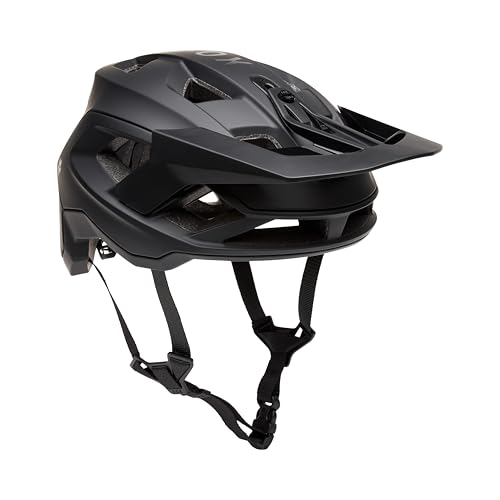
Fox Speedframe MIPS, Black
- CPSC 1203 certified trail half-shell
- MIPS rotational liner integrated into the fit system
- Adjustable visor with room to park goggles underneath
- Extended coverage at the rear of the skull and temples
If you buy one Fox helmet, buy this one. It is the shape that suits the widest range of riding: enough coverage for genuine trail work, enough airflow that you will not take it off on a climb, and a visor that earns its place in low sun and rain. It also works well for anyone on an electric mountain bike, where you climb faster and descend more often, which raises both the heat load and the exposure. The plain black is usually the cheapest option on the shelf and is mechanically identical to the graphics.

Fox Speedframe MIPS, Black Camo, Large
- Same shell and certification as the standard Speedframe
- Large shell size rather than a stretched fit ring
- Graphic colourway, typically a small premium over plain black
- MIPS liner and dial retention as standard
Listed separately because size availability is the thing that actually decides helmet purchases online, and large is where stock disappears first. Note the price gap between the plain and the graphic version of the same helmet: paint costs money and protects nothing. If your measured circumference sits on the boundary between two Fox sizes, take the smaller one and let the dial open, rather than the larger one relying on the dial to close.

Fox Youth V1 Motocross Helmet, Medium
- Off-road motorcycle full face, not a bicycle helmet
- Youth medium sizing, roughly 51 to 52 cm
- Peak and wide goggle aperture, no face shield
- Injection-moulded shell, the volume Fox youth MX option
The V1 is the helmet most young riders on a motocross track are wearing, and this is usually the cheapest way into it. It is a motorcycle product: enclosed, heavy for a small neck, and dependent on goggles because there is no face shield. Buy it for the head you are measuring today. A youth motocross helmet bought a size up so it will last two seasons can rotate on the head under load, and a helmet that moves during an impact is not protecting the part of the skull it was aimed at.

Fox Youth V1 Motocross Helmet, Matte Black, Large
- Youth large, roughly 53 to 54 cm measured circumference
- DOT FMVSS 218 is the applicable standard for track use
- Matte finish, usually cheaper than the loud graphics
- Removable and washable liner and cheek pads
Youth large is the size that overlaps with small adult heads, and it is where the sizing question gets awkward: a 14 year old with a 54 cm head is between the youth and adult charts. If the measurement falls in both, try both, because the youth shell is lighter and the adult shell has more shell sizes above it. Confirm the certification marking inside the shell of the model you receive before any track use.
Fox Youth V1 Motocross Helmet, Fluorescent Red
- High-visibility colourway, genuinely useful on open ground
- Youth medium sizing, roughly 51 to 52 cm
- Same shell and construction as the plain colours
- Costs more than matte black for the paint alone
The case for a loud helmet on a child is not styling. On open ground, at a practice track, or riding trails where an adult is trying to keep visual contact across a valley, a fluorescent shell is easier to track than a matte black one. Whether that is worth the paint premium is your call, but it is a more defensible reason to spend the extra than a graphic package. The shell underneath is identical.
Youth V1 sizing, done properly
Youth motocross sizing generates more returns than any other part of this range, and almost all of it comes from two mistakes.
Mistake one is buying by age. Head circumference and age correlate loosely and uselessly. An eight year old can measure 52 cm and a twelve year old can measure the same. Manufacturer charts that print age ranges do so because parents ask for them, not because they are meaningful. Measure the head.
Mistake two is buying room to grow. This is understandable and it is wrong. Motocross helmets are held in place by the compression of the cheek pads against the jaw as much as by the strap. A helmet that is one size too large will rotate under load, can be pulled off in a crash, and shifts on landings even when nothing goes wrong. Buy to the measurement, accept that you will replace it, and factor the replacement into the budget rather than into the size.
How to measure: soft tape around the widest part of the skull, roughly an inch above the eyebrows and above the ears, level all the way round, pulled snug but not tight. Take the number in centimetres and read it against the chart on the specific listing. Fox youth sizes run in tight bands, typically around 49 to 50 cm for youth small, 51 to 52 for youth medium and 53 to 54 for youth large, but charts vary by model year so check the one in front of you.
Then check the fit on the head. The cheek pads should press the cheeks noticeably when the helmet first goes on, enough that it feels tight for the first few minutes. With the strap done up, try to roll the helmet forward off the head from the back: it should not come off. Ask the child to shake their head hard; the helmet should move the skin, not slide on it. The same principles for bicycle helmets are covered in the sizing and safety guide.
The range compared
| Fox line | Type | Standard | Typical weight | Typical price |
|---|---|---|---|---|
| Mainframe | Entry trail half-shell | CPSC 1203 | 340 to 380 g | $60 to $80 |
| Speedframe | Trail half-shell | CPSC 1203 | 330 to 370 g | $110 to $130 |
| Speedframe Pro | Premium trail half-shell | CPSC 1203 | 300 to 340 g | $160 to $190 |
| Crossframe Pro | Gravel and cross-country | CPSC 1203 | 280 to 320 g | $180 to $220 |
| Proframe / Proframe RS | Bicycle full face | CPSC 1203 and ASTM F1952 | 750 to 900 g | $240 to $400 |
| V1 / Youth V1 | Motocross full face | DOT FMVSS 218 | 1,250 to 1,450 g | $150 to $260 |
| V3 / V3 RS | Premium motocross | DOT FMVSS 218 | 1,150 to 1,350 g | $400 to $700 |
Swipe sideways to see all columns →
The line that matters in that table is between the Proframe row and the V1 row. Above it, bicycle helmets. Below it, motorcycle helmets. Everything else is a comfort and weight discussion.
What Fox gets right
- Speedframe is competitive with anything in the trail half-shell category
- Proframe is a genuinely light bicycle full face you can climb in
- Deep coverage at the temples and occiput across the bicycle range
- Goggle integration is thought through, not an afterthought
- Enormous youth motocross presence, so sizes and spares are easy to find
Where it falls short
- Bicycle and motocross names sit side by side and get confused constantly
- Nothing serious in the road category, despite the brand recognition
- Graphics carry a real price premium over identical plain shells
- Youth motocross sizing bands are tight and easy to get wrong online
- Premium versions add comfort features while the certification stays the same
Which Fox helmet you need
Answer one question first: does the thing you are riding have an engine or a motor that sustains more than about 20 mph? If no, you are shopping the bicycle range. If yes, you are shopping the motocross range, and the DOT marking is not optional.
Within the bicycle range, the decision tree is short. Trail riding, ebike trail riding and general mountain use: Speedframe, or Mainframe if the budget is tight. Bike park, uplift days, enduro racing, anything where you would rather keep your teeth: Proframe. Gravel and cross-country where weight and airflow dominate: Crossframe Pro. Fast ebike commuting is the one case where Fox is not the obvious answer, because extended-coverage models built for sustained higher speeds are a different category, covered in the ebike helmet guide. If you are unsure how fast your bike will actually let you go, the ebike class explainer settles it.
Within the motocross range, the V1 covers recreational and club-level riding at a sane price, and the V3 buys shell material, weight reduction and liner quality. For a growing child, the V1 in the correct size beats the V3 in the wrong one every time.
If you want to see how another brand handles the same split, Bell runs an almost identical two-range structure with the same confusion attached. For the broader category view, start with the bike helmet buying guide, and if you ride in bright dust and low sun, eyewear matters more than most people expect on a trail helmet with a visor.