Bell Bike Helmets, From Supermarket Shelf to Motocross Track
Bell built the first modern bicycle helmet and now sells everything from a $28 commuter lid to a full motocross shell. Almost every buying mistake with this brand comes from not knowing which range you are looking at.
On this page
Bell has a genuine claim to inventing the product category. The company started making auto racing helmets in the 1950s, and in 1975 it released the Bell Biker, a hard-shell polystyrene helmet built for cyclists rather than a repurposed motorsport shell. Almost every bicycle helmet since has been a refinement of that idea: crushable foam, a thin hard shell, a chin retention system.
Fifty years later that history is also the source of the confusion. Type "Bell helmet" into a search box and you will get a $28 half-shell sold three aisles from the dog food, a $200 trail helmet stocked by bike shops, and a full motocross helmet built to a completely different federal standard. They share a logo and nothing else. A large share of the search traffic around this brand is people typing "Bell dirt bike helmets" who actually want a bicycle helmet, and people typing "Bell bike helmet" who are shopping for a kid on a 110cc pit bike.
So the useful thing this page can do is sort the range, then be honest about what climbing it buys you. The short answer on safety is that it buys you very little, because the floor is set by law and Bell is above it everywhere. What it buys you is airflow, weight, coverage and fit range.
Three Bells, not one
Understanding which shelf a helmet came off explains most of what you need to know about it.
The mass-market bicycle range
These are the helmets in supermarkets, department stores and general sporting goods chains, usually branded Bell or Bell Sports, priced from about $20 to $50. Names change frequently because retailers want exclusive models, which is why you will find a helmet in one chain that does not appear on Bell's own site.
The engineering is conservative and cheap to produce. Expect a universal fit ring rather than three shell sizes, a simple dial or a ratchet band, taped-on shells on the cheapest models rather than in-mold construction, modest vent count, and a weight somewhere north of 350 grams. Every one of them is certified. None of them is pleasant to wear for two hours in August, and that is the actual limitation: heat is the main reason helmets end up hanging on the hook.
The enthusiast bicycle range
Sold through bike shops and specialist online retail, roughly $60 to $300. This is where Bell puts its real work. Spark and Soquel cover the value end. Sixer is the trail helmet most people mean when they say they want a proper Bell. Super is the convertible full face family for enduro and bike park. Z20 and Formula sit on the road side. Falcon covers the middle of road and gravel.
What you get for the money here is multiple shell sizes rather than one stretched over a wide range, in-mold construction, deeper internal vent channelling, better retention hardware, goggle compatibility, and visor adjustment that actually holds position. Bell has shared a corporate parent with Giro for years, which is why the two brands' fit systems and technology names have drifted toward each other.
The powersports range
Bell's motorcycle division sells road helmets and off-road helmets, and the off-road ones are the MX and Moto families. These are motorcycle helmets. They are tested to DOT FMVSS 218, weigh in the region of 1,300 to 1,600 grams, use a different foam density and a fibreglass or carbon shell on the expensive models, and cost from about $100 for an entry MX-9 to well past $600 for a Moto-10.
If you are shopping for someone riding an electric dirt bike or a pit bike, this is the range you want, plus goggles, because MX helmets have no visor glass. If you are shopping for a bicycle, it is not.
CPSC, DOT, and why the distinction matters more than the price
This is the part of Bell shopping that people get wrong in a way that actually matters.
CPSC 16 CFR Part 1203 is the federal standard every bicycle helmet sold in the United States has been required to meet since 1999. It is a pass or fail test covering impact attenuation from specified drop heights onto flat and hemispherical anvils, in hot, cold and wet conditioning, plus a positional stability test that checks the helmet cannot be rolled off the head and a strength test on the retention system. There are no grades. The $28 Bell Revolution and a $250 Bell Super passed the same test.
DOT FMVSS 218 is the federal motorcycle helmet standard, and it is a different test at higher impact energies with a penetration requirement and a much heavier headform. A Bell MX-9 meets it. A Bell Sixer does not, is not intended to, and would be badly out of its depth on a motocross track. This is not a marketing distinction. It is the difference between two products designed for impacts at different speeds.
ASTM F1952 sits between them. It is the bicycle downhill full face standard, which is what a bicycle full face such as the Bell Super DH is built to when the chin bar is fitted. A helmet meeting ASTM F1952 is a bicycle helmet with a chin bar, ventilated and light enough to pedal in. It is not a motorcycle helmet.
Bell helmets worth buying, by job
These are chosen to cover different jobs rather than to rank one above another. Check the current independent ratings from the Virginia Tech Helmet Lab before committing, and check the shape against your own head, because head shape is the variable no spec sheet reports.

Bell Revolution MIPS
- CPSC 1203 certified adult bicycle helmet
- MIPS rotational liner at a supermarket price
- Universal fit ring, one shell across a wide size range
- Sold through general retail, so easy to try on before buying
This is the honest answer to "what is the cheapest helmet I should actually consider". It is certified, it has the rotational liner, and it costs less than a tank of fuel. The compromises are real: a universal fit ring means one shell stretched across a wide circumference by the retention band, so the fit is good on most heads and mediocre on a few, and the venting is adequate rather than good. For commuting, errands and short rides it is enough helmet. Put it on before you buy if you can, and check that it sits level rather than tipped back.
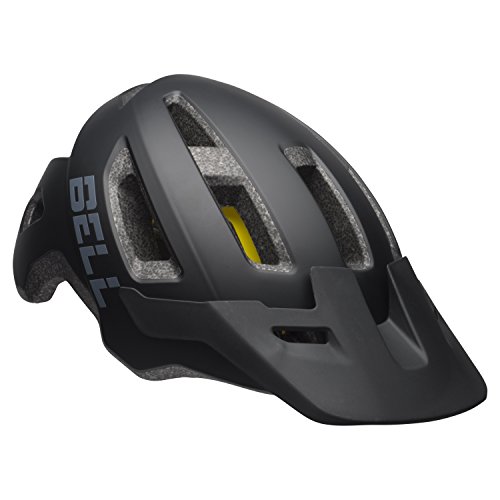
Bell Soquel MIPS
- CPSC 1203 certified, MIPS liner
- Mountain half-shell shaping with a visor
- In-mold construction, shell bonded to the foam
- Better vent channelling than the mass-market models
Soquel is the point where the range starts feeling like a bike shop product. In-mold construction bonds the polycarbonate shell to the foam during moulding rather than taping it on afterwards, which lets Bell cut bigger vents without weakening the structure. The half-shell mountain shape drops lower at the back of the skull than a road helmet, and the visor earns its place in low sun and rain. If you own one helmet and your riding is mixed, this shape is the more defensible buy.

Bell Sixer MIPS
- CPSC 1203 certified, MIPS liner
- Extended rear coverage, the deepest in Bell trail half-shells
- Adjustable visor that clears goggles when parked up
- Integrated mount point for a light or action camera
Sixer is the model that made Bell credible again on the trail side. The rear of the shell extends noticeably further down the occiput than the cheaper half-shells, which is where a lot of mountain bike impacts land when you go over the back or sideways. Multiple shell sizes mean the helmet is moulded to a size band rather than cinched into it. The camera and light mount is moulded into the shell instead of strapped on, which matters if you have ever had a strap mount rotate mid-descent. Graphics collaborations turn over constantly, and last season's paint is the same helmet at a discount.
Bell Youth MX-10 MIPS
- Off-road motorcycle full face, not a bicycle helmet
- MIPS rotational liner fitted
- Peak and wide goggle aperture, no face shield
- Youth sizing, measure the head and check the chart
This is the range people mean when they search "Bell dirt bike helmets". It is a motorcycle product: enclosed chin bar, no vents you would call generous, weight a young neck has to carry, and the goggle aperture rather than a visor. That weight point is worth taking seriously with children, because a heavy helmet on a small neck is its own hazard on a hard landing. Confirm the DOT marking on the shell of the exact model you receive before track or trail use, and pair it with proper goggles. Our guide to electric dirt bikes for teens covers the rest of the kit.

ROOZO Youth Full Face Off-Road Helmet
- Not a Bell product, listed as DOT certified
- Youth off-road full face with peak and goggle aperture
- Roughly a quarter the price of a premium youth MX lid
- Sensible when a head is still growing fast
Included because pretending otherwise is unhelpful: a nine year old will outgrow a helmet in eighteen months, and $220 is a lot to spend on something with a known expiry date. A DOT-marked budget shell meets the same federal minimum. What you lose is shell material quality, liner comfort, ventilation, weight and the resale value that Bell holds. If the riding is occasional and low speed, that trade is defensible. If the kid races, buy the better helmet and buy it in the right size.
The range compared
| Bell line | Type | Standard | Typical weight | Typical price |
|---|---|---|---|---|
| Revolution / Sports models | Mass-market half-shell | CPSC 1203 | 350 to 420 g | $20 to $50 |
| Spark / Soquel | Value bicycle half-shell | CPSC 1203 | 320 to 380 g | $45 to $70 |
| Sixer / Falcon | Enthusiast trail and road | CPSC 1203 | 280 to 350 g | $70 to $150 |
| Super family | Convertible full face | CPSC 1203, ASTM F1952 on DH versions | 600 to 850 g | $180 to $330 |
| Z20 / Formula | Road performance | CPSC 1203 | 240 to 300 g | $130 to $300 |
| MX-9 / MX-10 | Motocross full face | DOT FMVSS 218 | 1,300 to 1,500 g | $110 to $260 |
| Moto-9 / Moto-10 | Premium motocross | DOT FMVSS 218 | 1,200 to 1,400 g | $400 to $750 |
Swipe sideways to see all columns →
Read that table across rather than down. The jump that changes what the helmet is for is the last two rows, not the price. Everything above them is a bicycle helmet meeting the same legal requirement, differing in comfort. The bottom two are motorcycle helmets meeting a different one.
The motocross side, briefly
Bell's off-road motorcycle helmets run on a clear ladder. The MX-9 has been the volume seller for years: a polycarbonate shell, DOT certification, offered with and without MIPS, and priced where a weekend rider can justify it. The Moto-9 moves to a composite shell in multiple sizes, better liner materials, and the Flex system that layers three different densities of energy-absorbing material. Moto-10 sits at the top with the most expensive shell construction and the spherical rotational system.
Three things are worth knowing before you spend in this range. Shell count matters more than in bicycle helmets, because a motorcycle helmet moulded in one shell size across five head sizes carries a lot of surplus foam on a small head. Weight matters for neck fatigue over a two hour moto, and the difference between an entry helmet and a composite one is meaningful. And certification labelling has been changing, with ECE 22.06 appearing alongside DOT on newer models, which is a stricter European test and a reasonable thing to look for.
What Bell does not sell is a helmet that bridges the two worlds. There is no model that is both a legitimate motocross helmet and a sensible thing to pedal a mountain bike up a fire road in. If you ride both, buy both. The dirt bike helmet guide covers the off-road side in more depth, and the fastest electric dirt bikes explains where the speeds involved stop being bicycle speeds.
What Bell does well
- Genuine coverage of every price point, from $25 to $700
- Enormous retail distribution, so you can try the shape on in person
- Sixer and Super are competitive with anything in their categories
- Frequent graphics turnover means last season models discount hard
- Consistent fit language across the bicycle range, so sizing carries over
Where the brand frustrates
- Model names overlap confusingly across bicycle and powersports lines
- Retailer-exclusive mass-market models are hard to research or compare
- The universal fit ring on cheap models suits some heads and not others
- MIPS marketing implies a safety ranking the standard does not provide
- Nothing in the range bridges bicycle and motocross use, despite the naming
Bell fit and sizing
Measure your head with a soft tape around the widest part of the skull, roughly an inch above the eyebrows and ears, and buy to that centimetre figure against Bell's chart for the specific model. Size labels are not standardised between brands and only loosely standardised within one, so a Bell medium and a Giro medium are similar but not identical.
The bigger question with Bell specifically is shell count. A helmet described as universal fit uses one shell for a wide range, typically something like 53 to 60 cm, with the retention band doing all the work. That is a genuine cost saving and it is why the Revolution costs what it does. It also means that if your head is at either extreme of that band, the helmet will sit high or squeeze. The multi-shell models such as Sixer avoid this by moulding a small, medium and large shell.
Then run the standard checks. The front rim should sit about two finger widths above your eyebrows, not perched back on the crown. The side straps should meet in a V just below and slightly forward of the earlobe. One finger should fit under the chin strap and no more, and opening your mouth wide should pull the helmet down. Finally, grab the shell and try to roll it forward and back: if it moves independently of your scalp, tighten the dial, and if that does not fix it the shape is wrong for your head. Full procedure lives in helmet sizing, fit and safety ratings.
Which Bell is yours
Work backwards from the machine. If you are on a pedal bicycle or a Class 1 or Class 2 ebike, any CPSC-certified Bell is legal and adequate, and your decision is about ventilation and coverage. Commuting and errands: Revolution or Spark. Mixed riding and one helmet for everything: Soquel or Sixer. Serious trail riding: Sixer, or the Super family if you ride lifts. Road riding where heat and weight actually limit you: Falcon or Z20.
If you ride a fast ebike, the calculation changes, because impact energy scales with the square of speed and a bike sustaining 28 mph asks more of a helmet than one topping out at 15. Extended coverage models and the European NTA 8776 speed pedelec standard exist for exactly this reason, covered in the ebike helmet guide. If the class system is new to you, start with how ebike classes work, because the class determines the speed you will actually sustain.
And if you are shopping for a motocross track, a pit bike or a fast off-road electric machine, you want the MX or Moto range, a DOT marking on the shell, goggles, and a helmet that fits now rather than one bought to grow into.
Still narrowing it down? Start with the general helmet buying guide for how the categories compare across all brands, then read road helmets or mountain helmets depending on where you ride. If you want to see how a smaller premium brand approaches the same problem, POC is the interesting comparison, and helmet accessories covers the lights, mounts and pads worth adding once you have chosen.