Ebike Fenders and Mudguards: Coverage Beats Everything
Spray leaves a tyre in an arc. A short guard catches part of it, which is why clip-ons keep one patch of your back dry and nothing else.
On this page
Fenders are the accessory that changes an ebike from fair-weather to actually useful, and they are the one where the cheap version genuinely does not work. Not "works a bit less well". A seatpost-mounted rear guard leaves your feet soaked, your drivetrain gritty and your bag wet, and riders conclude that fenders do not help.
The reason is geometric rather than a question of quality. Water does not fly off a tyre in one direction, so a guard that covers one arc segment intercepts one arc segment. Understand where the spray goes and the whole category sorts itself.
The other half of the problem is that the fender you want may not physically fit, and on ebikes that is more common than on any other kind of bike. Wide tyres, suspension forks, no eyelets, and a motor at the rear all conspire against you. So this guide is half how fenders work and half how to find out whether the good ones will go on your bike.
Why full length wins, and by how much
A rolling tyre picks up a film of water at the contact patch and carries it round. That water leaves the tread tangentially, meaning at right angles to the radius, at whatever point it separates. Since separation happens continuously all the way round the rotating tyre, spray does not leave in a single jet. It leaves as a fan spread across the whole arc of the wheel.
The rear tyre throws water forward and up from the front of the wheel, straight at the seat tube and the drivetrain, and up and back from the top of the wheel, straight at your back and your bag. The front tyre is worse in an underrated way: the arc at the rear of the front wheel points directly at your feet, the bottom bracket, the chainrings and the downtube. That is the plume that soaks your shoes in the first mile and the one no clip-on addresses.
Now overlay the guards. A seatpost-mounted rear guard typically covers 40 to 70 degrees at the top of the wheel. It intercepts the segment aimed at your lower back and nothing else, which is exactly why riders report that their back stayed dry and everything else did not. A full-length rear fender covers roughly 180 to 210 degrees, from behind the bottom bracket, over the top, down past the axle. Add a mudflap on the front fender extending close to the ground and you have also closed the low-angle arc that throws water at your feet and at the rider behind you.
The difference is not marginal. Coverage angle is essentially the fraction of the spray you catch, so tripling the covered arc triples what you intercept. This is the entire argument, and it is why every purpose-built commuter bike ships with full fenders and no serious touring bike has ever used a clip-on.
Speed makes it matter more on an ebike. Spray velocity scales with wheel speed, so a bike cruising at 20 to 28 mph throws water harder and further than one at 12 mph, and it does so for a greater share of the ride because you are not soft-pedalling into a headwind. Everything in riding an ebike in the rain about where water gets into an electric bike is made worse by the absence of fenders.
The four types
Full-length fenders with stays
The proper answer. A long guard follows the tyre profile at a constant gap, held by two thin metal stays per end that bolt to eyelets at the axle, plus a mount at the fork crown or the brake bridge. Because the stays triangulate the fender, it stays where you put it and does not flex into the tyre. Materials are aluminium, stainless or plastic composite, and all three work; plastic is quieter and more forgiving of a knock, metal holds shape better.
Quick-release full-coverage fenders
A middle ground that has become popular on ebikes. These use a longer guard than a clip-on but attach with a strap or clamp system rather than eyelets, sometimes with a single strut. Coverage is better than a clip-on and worse than a stayed fender, and the appeal is that they fit bikes with no mounting points and come off in seconds. If your bike has eyelets, this is a compromise you do not need to make.
Clip-on and seatpost guards
A short blade on a seatpost clamp at the back, and a similar one strapped to the downtube at the front. Fast to fit, easy to remove, cheap. They exist for bikes with no clearance and no eyelets, and for riders who want something in a bag for occasional rain. Judge them as splash reduction rather than weather protection.
Integrated fenders
Fitted by the manufacturer, matched to the frame, usually with the wiring for the rear light run inside them. Nothing aftermarket fits as well, and if you are still choosing a bike, a model that ships with fenders, a rack and lights saves you three compatibility hunts. That is one of the sorting criteria in best commuter electric bikes.
| Type | Approximate coverage | Needs eyelets? | Typical price |
|---|---|---|---|
| Full length with stays | 180 to 210 degrees | Yes | $35 to $80 |
| Quick-release full coverage | 120 to 160 degrees | No | $25 to $50 |
| Clip-on seatpost guard | 40 to 70 degrees | No | $8 to $20 |
| Integrated from the factory | 180 to 210 degrees | Built in | Included in bike price |
Swipe sideways to see all columns →
Fitment is the real constraint
More fender purchases fail on fit than on quality. Four measurements settle it, and all four are things you can check in ten minutes.
Tyre width
Read the ISO size on the sidewall, which looks like 55-622 and means a 55 mm wide tyre on a 622 mm rim. The fender needs to be at least 10 mm wider than the tyre, and 15 to 20 mm wider is better, because spray that escapes past the fender edge is spray you did not catch. A 55 mm tyre wants a 65 to 75 mm fender. Fender listings usually quote a maximum tyre width, and that is the number to match, not the wheel diameter.
Vertical clearance
The gap between the top of the tyre and the underside of the fork crown or the seatstay bridge. You need enough for the fender plus a working air gap, which in practice means around 8 to 15 mm above the tyre. Too tight and mud packs between the tyre and the fender until the wheel locks, which is a genuinely alarming thing to have happen at speed.
Eyelets
Threaded holes at the dropouts for stays, plus a mount at the fork crown and one at the seatstay bridge. Their absence is what pushes riders to clip-ons. Many ebikes have rear eyelets, because the rack needs them, and no fork eyelets, because the fork is a suspension unit. Look before ordering: a stayed fender with nowhere to bolt the stays is a returned parcel.
The things in the way
Ebikes put hardware where fenders want to be. A rear hub motor has a wide hub shell and a cable exiting the axle, and the fender stays have to clear that cable. Rear rack struts often share the same eyelet as the fender stays, so you need a bolt long enough for both and the sense to stack them properly. Disc brake calipers sit right where a chainstay bridge mount would go. Torque arms on high-power hub motors take up space at the dropout too. None of these are fatal, all of them are worth looking at with the fender in your hand before you start.
The fat tyre problem
Fat tyre ebikes are one of the largest categories in the market, and fenders for them are one of the smallest. A 4 inch tyre is roughly 100 mm wide, so the fender needs to be 110 to 130 mm across to cover it properly. Most fender catalogues top out around 75 to 85 mm, because they were designed for hybrids and mountain bikes.
What this means in practice. Search on maximum tyre width, not wheel size, because a fender listed for 26 inch wheels may be a 60 mm guard that will not span your tread. Expect fewer options, higher prices, and more plastic than metal, because a wide fender needs stiffness across its width and plastic mouldings get there more cheaply than rolled aluminium. Expect to need longer stays too, since the fender sits further from the axle.
The pragmatic route for many fat tyre owners is to buy the bike with fenders fitted from the factory, which is why so many of these bikes ship that way. If you are retrofitting, measure everything twice, and be aware that on a 20 by 4 inch wheel the fender arc is short and fat, which is a different shape from anything a standard set will bend to. More on what those tyres do and cost you is in fat tire electric bikes, and the sizing conventions are unpicked in ebike tyres and wheels.
The front fender protects the bike more than it protects you
Riders fit a rear fender first because a wet back is the most obvious symptom. The front one does more work.
Water leaving the back of the front wheel travels rearward into the bottom bracket area, the chainrings, the front derailleur if you have one, and the underside of the downtube. It is not clean water. It carries road grit, and on winter roads it carries salt. That mixture is an abrasive slurry, and depositing it continuously onto a chain is the fastest way to wear out a drivetrain. Chains that would last 2,000 miles dry can be finished in a few hundred wet miles without a front fender.
On an electric bike there is a second layer. The downtube usually carries the battery mount, the charge port and a run of motor wiring, and the bottom bracket area on a mid-drive carries the motor housing and its sensor cabling. Connectors are sealed to a degree, but seals age, and a connector that receives salty spray at 25 mph for a whole winter is being tested harder than the one on a bike with a fender and a mudflap. The corrosion arguments in riding an ebike in winter apply doubly here.
A mudflap extending the front fender down close to the ground is the cheap add-on that finishes the job. It closes the low arc that throws water forward at your feet and back at your own bottom bracket, and on a group ride it is the difference between being welcome and not. Plenty of fenders ship with one; where they do not, a cut section of plastic and two rivets does it.
Fenders worth looking at

RBRL Full Coverage Fender Set for MTB and Ebike
- Full coverage set for 27.5 and 29 inch wheels with tyres up to 3.0 inches
- Wide enough for plus-size ebike tyres, which most sets are not
- Most expensive here, and the coverage is what you are paying for
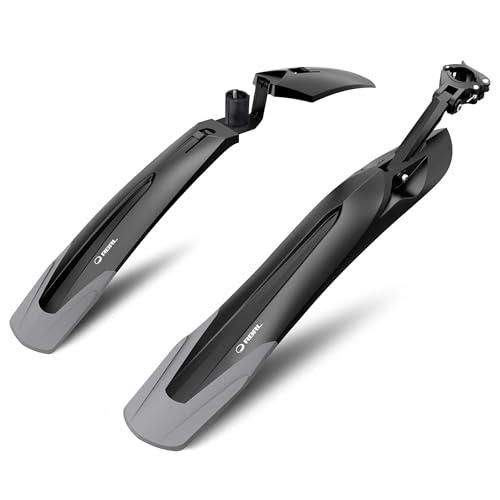
RBRL Quick Release Universal Fender Set
- Quick release mounting, listed for 24 to 29 inch wheels
- The answer when the fork has no eyelets, which is most suspension ebikes
- Comes off in seconds, which suits a bike that also gets ridden in the dry
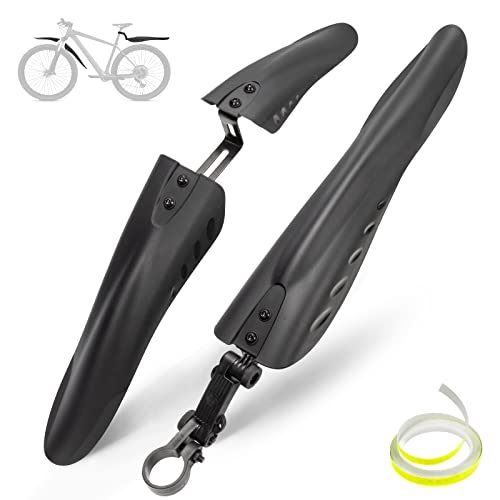
R2Depot Bike Fender Set
- Front and rear set listed for 22, 24, 26 and 27.5 inch wheels
- Cheapest way to get both ends covered rather than just your back
- Check your tyre width against the guard width before ordering

Cooryda Widened Quick Release Fender Set
- Widened profile, which matters more than length for spray escaping the edges
- Quick release attachment, front and rear included
- At this price expect plastic hardware, so check the fasteners after a week
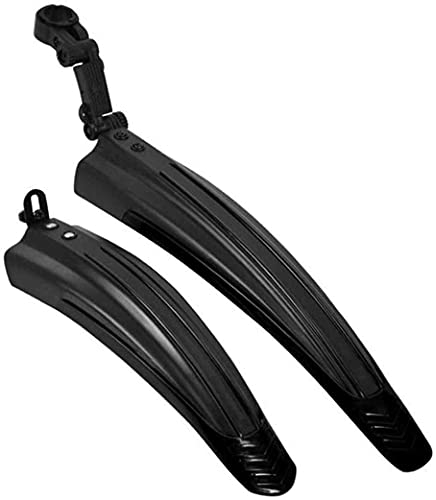
BlueSunshine Adjustable Clip-On Mudguards
- Adjustable clip-on front and rear, no eyelets or tools needed
- Splash reduction rather than weather protection, by design
- Buy this only if a stayed fender genuinely will not fit your frame
Rattle, stays and the safety detail nobody mentions
Fender rattle is the reason people take fenders off, and it is almost always fixable in twenty minutes.
The stays set the fender's position, and they need to be equal in length and tensioned so the fender sits at a constant gap from the tyre all the way round. If one stay is longer, the fender sits crooked, one edge sits closer to the tread than the other, and you get a buzz that changes pitch with speed. Cut or adjust the stays so the gap is even, tighten everything, and add a thin rubber washer under each stay bolt to damp the last of it. On an ebike this matters more because motor vibration adds a constant excitation that a regular bike does not have.
The safety detail is at the front. If something gets caught between the front tyre and a rigidly mounted fender, the fender can jam the wheel. Better front fenders use a safety release at the fork crown, a clip that lets the fender break away rather than lock the wheel. It is a feature worth looking for on any bike ridden fast, and it is one of the quiet differences between a good fender set and a cheap one.
What full fenders give you
- Dry feet, dry back and a dry bag in real rain
- Far less grit on the chain, so longer drivetrain life
- Less salty spray on connectors, mounts and the motor housing
- You stop deciding whether to ride based on the forecast
What they cost you
- A pound or two of weight and a small amount of drag
- Rattle if the stays are not set properly
- They make wheel removal slower at the roadside
- Fitting is fiddly on a crowded ebike dropout
How to choose
- Read your tyre sidewall. The ISO number gives width and rim size. Everything else follows from it.
- Look for eyelets. Dropouts, fork crown, seatstay bridge. If they are there, buy a stayed full-length set and stop looking.
- If there are no eyelets, buy quick release full coverage, not clip-ons. The coverage difference is the whole point of the purchase.
- Add 10 to 20 mm to your tyre width for the fender width. Narrow fenders leak at the edges regardless of length.
- Check clearance with the suspension compressed. A fork sags under load, and a fender that clears at rest can touch under a rider.
- Get a mudflap on the front. It is the cheapest coverage you will ever add.
If the bike is going to be used in weather at all, fenders belong in the first round of purchases alongside lights and a lock, ahead of anything cosmetic. That ordering is argued out in full in ebike parts and accessories. Once fitted, they change what else is worth carrying, because a dry bag on a dry rack is a different proposition from a soaked one, which is where ebike panniers and bags picks up. And if the bike is a load carrier or a school-run machine, the case for fenders is stronger still, since a child seat sits directly in the rear spray arc, as ebike child seats and electric cargo bikes both note.
One last thing worth settling before you spend anything on accessories: know which class your bike falls into and what that permits where you ride, because it changes the speeds you will actually travel at and therefore how much spray you generate. Start with ebike classes explained.