Cycling Shoes for Flat Pedals
The question behind the search is usually simpler than it looks: why do my trainers slide off the pedal, and what makes a cycling shoe different? Three things, and none of them is a cleat.
On this page
Most people arrive at this question after a specific moment. A foot slipped off a pedal on a climb, or a pinned pedal skated across a shin, or twenty miles in the arch started to ache in a way that felt like standing on a broomstick. The instinct is to assume the fix is clipping in. It usually is not.
A flat pedal shoe is not a clipless shoe with the cleat removed. It is a different design solving a different problem. A clipless shoe holds your foot with a mechanical latch, so the sole can be as stiff and as slippery as the designer likes. A flat pedal shoe has to generate all its retention through friction and geometry, which means the rubber, the profile and the tread pattern are doing the entire job.
That is why the answer to "can I just wear my running shoes" is a firm no, and why the reason is worth understanding. Once you know what makes a shoe grip a pinned platform, you can look at any pair in a shop and predict how they will behave.
Where grip on a flat pedal actually comes from
Friction between rubber and metal is the whole mechanism, and three properties of the shoe control it.
Rubber compound
This is the largest single variable. Outsole rubber is characterised by hardness, usually quoted on the Shore A scale, and by how much it deforms under pressure. A hard-wearing hiking or running outsole sits high on that scale and behaves like a slightly flexible plastic against a steel pin. A dedicated flat pedal compound sits considerably lower and behaves more like the rubber on a climbing shoe: the pin pushes into the surface, the rubber flows around it slightly, and you get mechanical interlock on top of plain friction.
The named compounds you will see are Five Ten's Stealth rubber, Vibram Megagrip, and various in-house compounds from Ride Concepts, Specialized, Shimano and Giro. They differ, but every one of them is softer than what you find on a general-purpose trainer. The trade is durability. Sticky rubber wears faster, and pedal pins leave permanent dimples in it from the first ride.
A flat, stiff sole
A pedal platform is a rigid rectangle roughly 100 mm square. Anything that curves away from that rectangle is not making contact. Running shoes are deliberately rockered, meaning the sole curves up at the toe and often at the heel to help the foot roll forward during a stride. On a pedal, that curvature means the contact patch shrinks to a band across the middle of the shoe, and the foot pivots on it.
Stiffness matters for a related reason. A pedal is a small platform under a large load, so the pressure at the edges of the platform is high. A soft sole lets the pedal edge press up into your foot, which is the source of the hot spot under the ball of the foot that riders notice at the one hour mark. A stiffer sole spreads that load across the whole footprint. It also stops the foot rolling sideways off the platform when you push through a corner or stand up on a climb.
Tread pattern
This is the one people miss. Deep aggressive lugs, the kind that make a hiking boot good on mud, are actively bad on a pedal. Only the tips of the lugs touch the platform, so the effective contact area collapses and each lug tip flexes independently. Pins land between lugs and find nothing to bite.
A flat pedal shoe uses a dense pattern of shallow siping, often a hexagonal or dot grid, across the middle third of the sole where the pedal sits. The gaps are small enough that a pin always lands on rubber, and shallow enough that the rubber does not flex away from it. Many designs then add real tread at the toe and heel, outside the pedal contact zone, so the shoe is still usable when you have to walk up something.
Why a running shoe fails, specifically
Every design decision in a running shoe is optimised for a foot striking the ground and rolling forward, and each one works against you on a pedal.
- The midsole compresses. A thick foam midsole is there to absorb impact. On a pedal, the load is constant rather than impulsive, so the foam simply squashes and stays squashed, and the pedal edge presses through it into your arch.
- The sole is rockered. Contact shrinks to a strip, and the foot rocks fore and aft on that strip every time the pedalling load changes.
- The tread is a waffle or a lug pattern. Pin engagement is close to zero, so retention depends entirely on friction from the lug tips.
- The heel is raised. A heel-to-toe drop of 8 to 12 mm tips your foot forward on a level platform, which quietly changes your ankle angle for the whole ride.
- The sole twists. Almost no torsional stiffness means that when you load one edge of the pedal, the shoe deforms and the foot follows it off the platform.
Put together, that is why a foot lifts off a pinned pedal over a bump and lands somewhere else, and why the correction feels alarming. The shoe never had a stable connection to break.
Sole stiffness is a spectrum, not a target
The temptation is to think stiffer is always better, because that is the direction race shoes go. It is not that simple on flats.
Too soft and you get hot spots. The classic symptom is a burning or numb patch under the ball of the foot that appears after 45 to 90 minutes and goes away when you stop. That is the pedal platform edge concentrating load on a small area of your forefoot. A stiffer midsole, or a nylon or composite shank through the middle of the sole, spreads it.
Too stiff and two things go wrong. Walking becomes awkward, which matters more than it sounds if you use the bike for errands and are on and off it constantly. And you lose the fine control that makes flats worth riding in the first place, because part of the appeal is being able to shuffle your foot slightly on the platform to change your position mid-ride.
The useful mental model is a scale. A skate shoe is a one. A dedicated flat pedal trail shoe is a four or five. A clipless trail shoe is a seven. A carbon-soled road shoe is a ten. For most riders, including almost everyone on an electric bike, four to six is right.
Signs a shoe will work on flats
- Sole is visibly flat from toe to heel when set on a table
- Tread through the middle third is shallow and densely siped
- Sole resists twisting when you wring it toe against heel
- Rubber feels tacky under a thumbnail rather than hard and slick
- Low or zero heel-to-toe drop
Signs it will not
- Deep lugs or a knobbly outsole across the whole sole
- A visible rocker or a curved-up toe
- Thick soft foam midsole with no shank
- A recessed two-bolt cleat pocket you have no plan to use
- A mesh upper with open weave, which lets pin damage and water straight through
Pins, platforms and why the shoe is only half the system
A shoe cannot grip pins that are not there. Plenty of stock pedals on complete bikes are moulded plastic or plain aluminium with shallow moulded ridges, and no shoe on earth grips them well in the wet. If you are buying shoes to fix a slipping problem, look at the pedal first.
What a good flat pedal has is a wide platform, replaceable steel pins threaded through from underneath, and a slightly concave profile so the middle of the platform sits lower than the edges. The concavity matters because it lets the sole wrap very slightly, which stops the foot pivoting. Pin length is adjustable in practice: most pedals ship with pins you can shorten by adding washers or swap for shorter grub screws.
Longer pins mean more grip and more damage, both to your shoe and to your shin when a pedal comes back at you. Shorter pins are kinder and let you reposition your foot more easily. Riders often run longer pins at the outside edges of the platform and shorter ones in the middle, which resists the specific failure mode of the foot rolling outward.
Foot position on the platform matters too. The ball of the foot slightly forward of the pedal axle is the usual starting point, which is a little further forward than most people naturally place it. If you feel like you are pedalling with your arches, you are too far back, and no shoe will fix that.
Skate shoes: close, and worth understanding
Skate shoes get a lot right by accident. Vulcanised gum rubber is soft and grippy, the sole is genuinely flat because skaters need board feel, the tread is shallow, and the uppers are usually reinforced canvas or suede that survives abrasion. For short rides they are a perfectly reasonable choice, and for years they were what mountain bikers actually wore.
Two things hold them back. First, there is no shank and very little midsole structure, so on any ride past about an hour you feel the pedal through the shoe and the hot spot arrives. Second, the outsoles are thin, and pedal pins punch through them faster than most people expect. A pair of skate shoes used as bike shoes will show pin holes in a season.
The interesting result is that several bike brands now build what is essentially a reinforced skate shoe: same silhouette, same gum outsole, but with a stiffer midsole and a reinforced toe. Crankbrothers' Stamp Street line is the clearest example. If you like the look and the feel of a skate shoe but ride further than a skater walks, that is the category to shop.
What changes on an electric bike
All of the above applies to any bike. Three things make it sharper on an ebike.
Speed and mass. A foot slipping off a pinned pedal is unpleasant on a 25 lb bike at 12 mph. On a 60 lb bike at 22 mph it is a genuinely bad outcome, because the pedal keeps rotating under power, the bike carries far more momentum, and a leg that drops toward a spinning crank has less time to recover. Our explainer on how fast ebikes actually go lays out why the speeds are higher than most riders assume, and the class system determines whether your bike assists to 20 or 28 mph.
Static feet. On a throttle-equipped Class 2 bike, riders often coast for long stretches with feet in one fixed position. On a normal bike, pedalling constantly redistributes pressure across the foot. Sit still on a soft sole for twenty minutes and the hot spot arrives faster, not slower. That argues for the stiffer end of the range if you use a throttle a lot.
Vibration and weather. Ebikes get ridden year round more than analogue bikes do, partly because the assist removes the excuse. That means wet pedals, which is exactly when soft compound rubber earns its money, and it means cold, where a mesh summer shoe becomes miserable. Anyone riding through the cold season should read our winter ebike guide, and the drainage question is covered in riding an ebike in the rain.
The one place clipless still wins outright is sustained climbing on an electric mountain bike, where being able to pull through the top of the stroke on a steep technical pitch is worth something. For commuting, errands and general trail riding, flats plus a proper shoe is the easier and safer setup.
Shoes worth looking at
Sizing across cycling brands runs narrow and short compared with running shoes, so size up if you are between sizes and check the brand's own size chart rather than assuming your usual number. Prices below are what these listed for when we sourced them.
Giro Tracker Fastlace
- Fastlace closure with a lace keeper, so nothing dangles near the chainring
- Mountain bike outsole, flatter and denser than a hiking tread
- Synthetic upper with reinforced toe
- Sold in a wide size run, listed here in US 7.5 / EU 40
Giro has been making bike shoes for a long time and the Tracker sits in the middle of the stiffness range that suits most riders. The Fastlace system is the sensible closure for a shoe you take on and off several times a day: one pull tightens it, and the excess tucks into a pocket instead of hanging where a crank can catch it. Check the specific listing before you buy, because Giro sells trail shoes in both flat and two-bolt clipless sole versions and the photographs are easy to confuse.
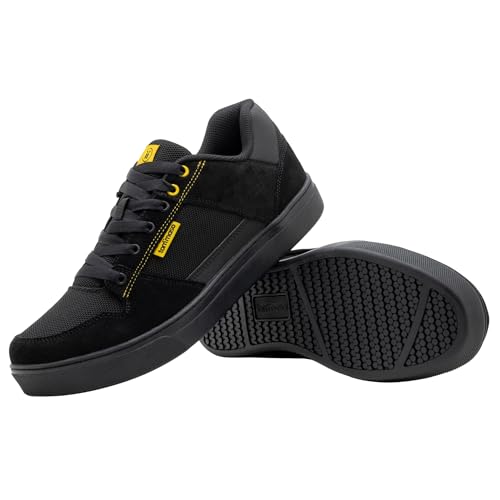
Tommaso Comodo Flat Pedal MTB Shoe
- Built specifically for flat pedals, no cleat pocket
- Lace closure with a conventional trainer fit
- Rubber outsole with a flat central contact zone
- The cheapest way to stop riding in trainers
Tommaso sells direct and prices accordingly, and the Comodo is aimed squarely at riders making the jump from trainers. Do not expect the sticky compound of a premium trail shoe, and do expect a firmer sole than a skate shoe. For a commuter putting in a few hundred miles a year on a pinned pedal, that combination is most of the benefit for half the money.

Crankbrothers Stamp Street Fabio
- Gum rubber outsole, the compound skate shoes use
- Skate silhouette with bike-specific midsole reinforcement
- Vulcanised construction with a flat profile
- Listed here in size 11, black and gold
This is the answer to "I want a skate shoe that survives being a bike shoe". Crankbrothers designs the Stamp pedal, so the shoe and pedal were developed against each other, which is more than most shoe brands can say. It walks well, it does not look like cycling kit, and it is the pick for anyone who wants one pair of shoes for the ride and the rest of the day.

Giro Tracker BOA
- BOA dial closure, adjustable in small increments while riding
- Same outsole platform as the laced Tracker
- Nothing to come untied or catch on a crank
- Listed here in US 11.5 / EU 45.5
A dial is genuinely useful if your feet swell on long rides or if you want to loosen a shoe at a stop without getting off the bike. It is also one more thing that can break, though BOA replaces dials under warranty and the parts are widely available. If you ride in mud regularly, a dial is easier to clean than a lace.

Sandugo Flat Pedal MTB Shoe
- Speed lace and dial closure at a mid-range price
- Sold explicitly as a flat pedal shoe
- Aimed at trail and enduro use, so the upper is reinforced
- The budget route into a dial closure
A lesser-known brand at a price that undercuts the established names for a similar feature list. The unknown with any shoe from a smaller brand is the rubber compound, which nobody publishes a number for and which is the property that actually matters. Buy from somewhere with an easy return policy and test them on your own pedals in the first week.
| Shoe | Closure | Best for | Price |
|---|---|---|---|
| Giro Tracker Fastlace | Speed lace | Most riders, most of the time | $75 to $95 |
| Tommaso Comodo | Laces | First pair, commuting | $59.99 |
| Crankbrothers Stamp Street | Laces | Off the bike as much as on | $139.99 |
| Giro Tracker BOA | Dial | Long rides, swelling feet | $88.00 |
| Sandugo MTB | Speed lace and dial | Dial closure on a budget | $74.99 |
Swipe sideways to see all columns →
How to choose, in order
- Fix the pedal first. Pinned aluminium platforms, concave, with steel pins. Without them the shoe cannot do its job.
- Decide how far you ride in one go. Under an hour, a skate-style shoe is fine. Over an hour regularly, you want a shank and a firmer midsole.
- Decide how much you walk in them. Errand riders and delivery riders spend a surprising share of the day off the bike, which pushes toward a shoe that flexes at the ball of the foot. If that is you, our guide to ebikes for food delivery covers the rest of that kit.
- Pick the closure. Laces are cheapest and most reliable, speed laces are the best compromise, dials are the most convenient and the only ones with a failure mode.
- Size up if in doubt. Cycling shoe lasts run narrow and short compared with running shoes.
- Check the sole is flat. Set them on a table and look from the side. A visible rocker means the design brief was walking, not pedalling.
One last honest note. Shoes are a mid-priority purchase. If you are working through a list, a lock and lights come first, then contact points, and shoes belong in the same tier as grips and a saddle. Our roundup of commuter ebikes covers what to look for in the bike itself, and ebike maintenance and repair handles the pedals, bearings and everything else that wears out around your feet.