Ebike Mirrors, Bells and Horns
Three cheap items that change how drivers and pedestrians deal with you. The thread connecting them is that an electric bike arrives sooner than anyone watching expects.
On this page
A driver glances at a bicycle, estimates 12 mph, and pulls out. You were doing 24. A pedestrian steps sideways onto the path without looking, because the last bike that passed took four seconds to cover the ground you covered in two. Neither of them made an unreasonable judgement given what a bicycle usually does. That mismatch is the reason mirrors, bells and horns belong in the same article.
Everything in this guide is cheap. A mirror, a bell and a horn together cost less than a set of tyres, and they change more about how a ride feels in traffic than most upgrades costing ten times as much. What they need to do, though, is slightly different on an electric bike, and that difference is worth understanding before you spend even the small amount of money involved.
Why the ebike case is different
Three things change once a bike is electric and heavy.
Closing speed. A Class 3 ebike assists to 28 mph and a Class 1 or 2 to 20 mph, which is covered properly in our explainer on ebike classes. Those are cruising speeds, not sprints, and they are sustained on flat ground and uphill alike. Other road users calibrate on what bicycles usually do, and what ebikes actually do is faster for longer.
Mass and stability. A shoulder check on a 22 lb road bike costs you almost nothing. On a 60 to 75 lb ebike, rotating your torso to look behind moves a large share of the system's mass and steers the bike, and at speed that is a real wobble. This is the single strongest argument for a mirror, and it applies even more to riders with limited neck rotation, which is part of why our guide to ebikes for older riders treats mirrors as standard rather than optional.
Quietness. A hub motor at cruise makes almost no noise, and there is no drivetrain clatter from someone who is not pedalling hard. On a shared path you approach people silently at twice the speed they expect. That is exactly the situation a bell exists for.
Mirrors
The vibration problem
Most people who say bike mirrors do not work have used a bad one. The failure mode is specific: the mirror head sits at the end of a long thin stalk, the stalk has a natural resonant frequency, and the buzz coming up through a rigid aluminium frame at 20 mph sits close enough to that frequency to set it ringing. The image smears into a grey blur at precisely the speed where you need it most.
Ebikes make this worse for several reasons at once. The frames are stiff and heavily built, so vibration transmits rather than being absorbed. Many ride on high-pressure or heavily loaded tyres. And the speeds are higher, which shifts the excitation frequency up into the range where small parts resonate.
What fixes it is short and solid. A mirror mounted close to the bar, with a head that has some mass to it, on a joint that clamps down rather than relying on a friction ball. Bar-end mirrors get this right almost by definition, because an expander plug inside the bar tube is a far more rigid mount than a clamp on the outside. If you already own a mirror that blurs, try dropping tyre pressure a few psi before replacing it; on a fat-tyre bike that alone can be enough.
Bar-end against clamp-on against helmet
Bar-end mirrors fit into the open end of the handlebar with an expander wedge. They are the most stable option, they sit furthest outboard so your view is mostly lane rather than your own arm, and they are the least likely to move once set. The catches are that your bar ends must be open and accessible, which rules them out if you have bar-end shifters or plugged bars, and that they add width, which matters if you store the bike in a narrow space or ride through gaps.
Clamp-on mirrors attach to the bar itself or to the brake lever clamp. Easier to fit almost anywhere, easier to fold in, and available in far more variants. The good ones use a short arm and a proper pinch bolt. The bad ones use a long stalk and a plastic ball joint, and they are the mirrors that gave the category its reputation.
Helmet and glasses mirrors are small mirrors on a boom clipped to a helmet or spectacle arm. They move with your head, which means you aim them by looking, and the field of view they cover is enormous compared with their size. They take a week or two to get used to, some riders never adapt, and they only work if you wear the same helmet every ride. They also survive the bike being knocked over. If you want to try one, they are the cheapest experiment in this article. Our roundup of bike helmets covers what to fit one to.
Flat glass against convex
A convex mirror shows a much wider field for the same physical size, which is why almost all bike mirrors are convex. The cost is distance perception: objects appear smaller and therefore further away than they are. This is the same reason cars carry a printed warning on the passenger door mirror.
The practical workaround is a reference point. Aim the mirror so that a sliver of your own shoulder or upper arm sits at one edge. Your brain uses that known object to scale everything else, and judgement improves immediately. A flat glass mirror gives true distance but such a narrow field that you end up moving your head to scan, which defeats the purpose.
What a mirror genuinely gives you
- A lane check without moving your body on a heavy bike
- Early warning of a vehicle closing faster than you expected
- The ability to time a lane change instead of guessing
- Confidence to hold a road position rather than hugging the gutter
- Useful on shared paths for riders overtaking you
What it does not
- It does not cover the blind spot immediately behind and beside you
- It does not replace a shoulder check before a lane change on a fast road
- It will not survive the bike falling on that side
- A convex mirror will always compress distance
- It adds width, which matters in bike storage and door gaps
Bells, the law, and what a bell is for
Start with the legal position, because it is more often mandatory than riders assume. New York State requires every bicycle to carry a bell or other device audible from at least one hundred feet, and in the same sentence prohibits fitting a siren or a whistle. Germany requires a bell as part of the road-legal equipment set. The Netherlands and Denmark require one. In England a bell must be supplied with a new bicycle, though there is no requirement to keep it fitted. Plenty of US cities have their own ordinance on top of state law. Check yours; the fine is trivial and the point is that a bell is often not optional.
Beyond the law, a bell does a job no other device does. The sound of a bicycle bell is culturally understood. A pedestrian hears it, categorises it as a bike, and looks over their shoulder. They do not jump. That recognition is the entire value, and it is why a bell used at twenty metres works better than any amount of volume used at three.
What separates bells is tone and duration. A cheap plastic bell makes a short flat click. A good brass or aluminium bell rings with a clear tone that sustains for a second or more, and a sustained tone carries through wind noise and headphones far better than a short one. Weight in the dome is what produces it, which is why the good ones feel heavy for their size.
Two mechanisms are common. The classic rotary striker, thumb-flicked, gives one loud clear ring. The continuous ding-dong style, common on Dutch and cruiser bikes, produces a longer softer sound that reads as friendly rather than urgent. For shared paths the friendly one is often the better tool.
Horns, honestly
The electric bike horn category is dominated by small rechargeable units advertising 120 dB, usually with several selectable sounds. They are cheap, they mount in a minute, and they are more useful and more problematic than the marketing suggests.
Take the number first. Sound pressure ratings are quoted at a stated distance, usually very close to the device, and sound pressure falls roughly 6 dB for each doubling of that distance. A horn measured at 120 dB at one metre is nothing like 120 dB at the window of a car five metres away, with that window closed and the radio on. The honest way to read the figure is as a category marker: these are considerably louder than a bell, and comparable in the ballpark to a small car horn, not as a promise about what a driver hears.
What they do well is produce a noise with the acoustic signature of a vehicle. A driver drifting into your lane responds to that because it maps onto something they already have a reaction for. A bicycle bell, in the same situation, is often inaudible inside a closed car and does not carry the same meaning even when it is heard. In real traffic, a horn is a genuinely useful piece of equipment.
What they do badly is anything involving people on foot. A 120 dB blast at close range makes someone jump, and a startled pedestrian moves in an unpredictable direction, sometimes into you. It also reads as aggression, which is the opposite of what you want on a path you will use again tomorrow. Riders who fit a horn and use it on everything end up in more conflicts, not fewer.
On the hardware side, look for a rechargeable battery over disposable cells, a water resistance rating of at least IPX4 since it lives on the outside of the bike, a clamp sized to your bar diameter, and a single sound rather than a novelty set of eight. Ambulance and police sounds are illegal to use in most places and will get you a much worse conversation than the one you were trying to avoid. Where the horn is exposed to weather, the same durability logic applies as in riding an ebike in the rain.
The shared path argument
Path conflict between electric bikes and pedestrians is the single biggest reason for local ebike restrictions, and most of it comes down to warning timing rather than speed. The useful rule is simple: a warning given early is received as courtesy, a warning given late is received as a demand.
In practice that means ringing a bell at fifteen to twenty metres, not five. It means slowing before you signal rather than after, which tells the person you have already given up the speed and removes the sense that they must move. It means a second, softer signal if the first got no response, rather than escalating volume. And it means passing wide, because a pedestrian who has not looked round does not know which side you chose.
None of this is about the equipment, but the equipment shapes it. A bell you can reach with your thumb gets used early. A horn on a thumb button gets used late, because you only reach for it once the situation is already tight. Fit both if you like, but be clear in your own head which is for whom.
What to buy

Mirrycle Mountain Mirror
- Bar-end mount using an internal expander plug
- Convex glass in a housing with real mass to it
- Long-running design sold for flat and riser bars
- The mount type least affected by frame vibration
The Mirrycle has been on commuter handlebars for decades and it is the default recommendation for a reason: the expander plug mount is rigid, the head does not flutter, and it stays where you put it. Check your bar ends are open and that you have room outboard of the grip before ordering. It is also the mirror most likely to survive the bike being wheeled through a doorway, because it folds in against the bar rather than snapping off a stalk.

Wittkop Bike Mirror
- Large HD mirror face for a wide field of view
- Rotates 360 degrees and folds flat against the bar
- Mounts above or below the handlebar
- Break-resistant construction rather than glass
The pick when bar-end mounting is not available, which on a loaded ebike cockpit is often. Mounting below the bar is the underrated option here: it keeps the mirror out of the way of a shoulder bag and away from the first thing that hits the ground. As with any clamp-on, tighten the pivot properly on the first ride and check it after a week, because a joint that slips is a joint that has to be reset at every stop.

BriskMore Handlebar Mirror
- HD glass mirror face rather than acrylic
- 360 degree adjustment and folds inward
- Handlebar clamp mount
- Cheap enough to try mirrors without committing
Glass rather than acrylic is worth noting, because acrylic mirror faces scratch and craze and end up hazy within a season. At this price the thing to watch is the pivot, which is the part that always fails first on inexpensive mirrors. If you have never ridden with a mirror and want to know whether you would use one, this is the low-risk way to find out.
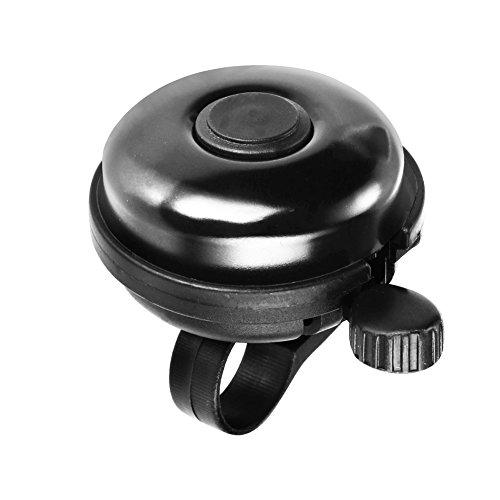
Accmor Classic Aluminium Bike Bell
- Aluminium dome, which is what produces a sustained ring
- Classic thumb-flick striker mechanism
- Small clamp footprint for a crowded cockpit
- Cheap enough to fit one to every bike you own
There is very little to a bell and that is the point. Metal dome, thumb lever, small clamp. The only real decision is where it fits on a bar already carrying a display, a throttle, brake levers and possibly a light, so measure the free space before you order. If your local rules require an audible signal, this is the cheapest way to comply and it is the right tool for shared paths.

LESOVI 120 dB Electric Bike Horn
- Rechargeable battery, so no disposable cells to replace
- Multiple selectable sounds, of which you will use one
- Water-resistant housing for outdoor mounting
- Handlebar clamp with a remote thumb button
Treat the 120 dB figure as a category marker rather than a measurement at any useful distance. What you are buying is a vehicle-shaped noise for use around vehicles, and on a commute through real traffic that is worth having. Pick one sound and leave it there. Avoid the emergency-vehicle imitations entirely; using them is illegal in most jurisdictions. If you ride for work in traffic all day, this belongs on the same list as everything in our delivery ebike guide.
| Item | Type | Best for | Price |
|---|---|---|---|
| Mirrycle Mountain Mirror | Bar-end mirror | Stability at speed | $15.22 |
| Wittkop Bike Mirror | Clamp-on mirror | Crowded handlebars | $14.99 |
| BriskMore Handlebar Mirror | Clamp-on mirror | Trying a mirror cheaply | $16.99 |
| Accmor Classic Bell | Bell | Pedestrians and legal compliance | $5.98 |
| LESOVI Electric Horn | Horn | Cars and closed windows | $13.88 |
Swipe sideways to see all columns →
Fitting and setting up
Handlebar clamp diameter is the measurement that trips people up. Grip sections on most bars are 22.2 mm, which is what nearly all bells, horns and clamp-on mirrors are made for, but the bulge near the stem is 31.8 mm or 35 mm and nothing small will clamp there. Measure with calipers, or wrap a strip of paper around the bar and measure its length. Many accessories ship with a rubber shim for the smaller sizes.
Set the mirror while sitting on the bike in your normal riding position, not while it is on a stand. Aim for a sliver of your own shoulder at the inner edge and the rest of the frame filled with the lane behind. Ride it for a week before deciding it is wrong, because the adaptation period is real and most people aim a mirror too far outboard on the first attempt.
Cockpit space is the constraint that shapes all of this. An ebike bar already carries brake levers, a display, a throttle on many bikes, shifters, and often a light and a phone mount. Work out the order before you start: mirror at the very end or just inboard, then the light, then the bell where your thumb naturally rests, then the horn wherever is left. If you also plan to run turn signals, read ebike lights and turn signals first, because signal switches want the same real estate.
Finally, check everything after the first hundred miles. Vibration on a heavy bike backs bolts out, and the failure mode of a mirror clamp is that it slowly rotates until it points at your knee. A drop of medium-strength thread lock on the clamp bolts of anything that has migrated once is a sensible response, and it belongs on the same checklist as the rest of ebike maintenance.
If you are still deciding what to fit first on a new bike, our roundup of ebike parts and accessories worth buying ranks these against everything else, and best commuter electric bikes covers what to look for in the bike underneath them. Anything that improves how early you can react is worth more than anything that improves how fast you can go, and that includes the brakes.