Cycling Gloves: What Actually Fixes Numb Hands
The most common reason people buy padded gloves is numbness, and thick gel in the wrong place makes numbness worse. Here is the mechanism, and the order in which to fix it.
On this page
Somewhere around the thirty minute mark, two fingers go dead. Most riders reach the same conclusion: the bars are too hard, so buy padding. That reasoning is intuitive and usually wrong, and following it can turn a mild annoyance into something that lasts hours after the ride.
Numbness while cycling is nerve compression. Two nerves run through the wrist and the base of the palm on their way to the fingers, and both of them pass through places where your body weight is pressing on the handlebar. Adding a thick pad on top of the compression point does not relieve pressure; it concentrates it. The pad only helps when it is shaped and placed to carry load somewhere the nerve is not.
Gloves are still worth buying. They protect your hands in a crash, they keep sweat off the grips, they stop wind stripping heat off the back of the hand at 22 mph, and a well-designed palm genuinely does spread load. They are just fourth on the list of fixes, not first.
What is actually happening to your hands
Two nerves matter. The ulnar nerve enters the hand through a narrow passage on the little-finger side of the wrist, sitting just under the pad of muscle at the base of the palm. It serves the little finger and half the ring finger. Cyclists compress it by resting body weight directly on that pad of muscle, which is exactly where a flat bar or the tops of a drop bar tend to sit. The result has a name in the medical literature, handlebar palsy, and in its more developed form it includes weakness as well as tingling, particularly a struggle to spread the fingers.
The median nerve runs through the middle of the wrist, through the carpal tunnel, and serves the thumb, index and middle fingers. Cyclists compress it mostly through wrist angle rather than direct pressure. If your wrist is bent backward more than roughly twenty degrees while you hold the bar, the tunnel narrows and the nerve gets squeezed. That is why numbness in the thumb side of the hand often improves the moment you raise the bars or rotate them.
Both are pressure and time problems. The pressure is your upper body weight divided between two small contact patches; the time is the number of consecutive minutes it stays in one place. Anything that reduces either one helps. Anything that increases local pressure at the nerve makes it worse, and a thick domed gel pad centred on the base of the palm does precisely that.
The fix order, cheapest and most effective first
1. Get weight off your hands
The single biggest lever. If your saddle is nose-down, gravity slides you forward and your arms carry the difference. Level the saddle first; it is free and it is the most common cause. Then look at bar height. Raising the bars 20 to 30 mm with spacers or a taller stem rotates your torso up and transfers load back onto the saddle. A shorter stem does something similar by reducing reach. Our guide to ebike seats and saddles covers the saddle side of this, and the two problems are more connected than they look.
2. Change the grip
Grip diameter changes pressure directly, because pressure is force divided by area. A larger diameter grip spreads the same load over more of your palm. Ergonomic wing grips go further by adding a flared shelf that carries weight on the fleshy outer edge of the palm rather than on the nerve passage. They are unattractive and they work. Lock-on grips are the ones that do not twist when wet. Budget $25 to $50, which is less than a good pair of gloves.
3. Move your hands
Drop bars have three or four positions, which is the real reason road riders get away with such an aggressive posture. A flat bar has one. If you ride a flat-bar ebike for more than an hour at a stretch, either fit bar ends or swept-back bars to create a second position, or make a habit of consciously shifting your hands every ten minutes. This is free and it is the fix most people never try.
4. Then, padding
Now the glove matters, and now it matters in the specific way described in the next section.
Where padding belongs, and where it does not
Look at the palm of a well-designed cycling glove and you will see the padding is not a single slab. It is split into separate pads with channels between them. The channels are the point. They run along the paths the nerves take, so the pads carry load on either side and leave the sensitive corridor unloaded. The design term for this is a bridge, and the difference between a $12 glove and a $30 one is very often whether anyone thought about it.
Three padding materials show up. Gel is dense, conforms well, and stays put; it is the standard for road and commuting gloves. Foam is lighter, breathes better and compresses faster, which makes it feel plush early and thin out over a long ride. Some gloves use both, with gel at the heel of the palm and foam under the fingers.
Thickness is where buyers go wrong. Pads in the 3 to 5 mm range are already substantial. Thicker pads do three unhelpful things: they force your hand to open wider around the bar, which stretches tendons and increases wrist extension; they reduce your feel for the brake levers, which is a real safety cost on a heavy bike; and they bulk up the exact area you wanted to unload. If you want more cushioning than a 5 mm pad, the answer is a fatter grip, not a fatter glove.
A well-designed padded palm
- Separate pads with clear channels between them
- Padding concentrated at the heel of the palm on the thumb side and the outer edge
- A visible gap where the ulnar nerve passage sits
- Palm material with a small amount of stretch, so it does not bunch
- Seams routed away from the contact area
A badly designed one
- One continuous slab of gel across the whole palm
- Padding thickness quoted as a headline feature
- Thick seams running straight across the palm
- A loose fit that folds when you grip the bar
- Padding on the back of the hand, which does nothing for comfort
The glove types, and who each is for
Half finger
The classic cycling mitt, cut off above the first knuckle, usually with a mesh back and pull tabs at the fingers. Coolest option, easiest to take off, and lets you use a phone or handle keys without removing them. The downside is fingertips exposed in a crash, and less grip on levers in the rain. For summer riding on quiet routes they are the comfortable choice.
Full finger
Covers the whole hand. On an ebike this is the default we would recommend, for three reasons: fingertips are what hit the ground first in most low-speed falls, a covered finger grips a wet brake lever far better than bare skin, and the extra coverage takes the edge off cold mornings without being a winter glove. Modern full finger gloves are thin enough that the summer heat penalty is small.
Winter insulated
Thicker, with insulation, a windproof membrane, and usually a longer cuff that goes over or under a jacket sleeve. The key specification is windproofing rather than insulation thickness, for reasons covered below. Most also drop the palm padding almost entirely, because the insulation itself provides cushioning and a thick pad plus thick insulation makes a glove you cannot brake in.
Lobster and split finger
Three-finger designs that pair the index with the middle finger and the ring with the little finger. Adjacent fingers share heat while you keep enough dexterity to brake and shift. They are the warmest thing you can wear that still works on a bike, warmer than a five-finger glove of the same thickness, and they look ridiculous. For riding below about 20 F they are the honest answer.
Liner plus shell
A thin merino or synthetic liner under a windproof overshell. More versatile than a single thick glove because you can drop the shell when you warm up, and the liner alone covers autumn temperatures. It is also the system that handles a long ride where conditions change, which is why it shows up in our guide to ebike touring and bikepacking.
Materials, closure and fit
The palm should be synthetic leather. Amara and Clarino are the two names you will see, and both are microfibre materials that resist abrasion, stay flexible when wet, and survive being washed. Real leather is durable and grippy but goes stiff after it gets soaked and dries. Plain textile palms wear through fast at the base of the thumb.
Silicone printing on the fingers adds grip on levers and is worth having on any glove you will use in the rain. A terry or microfibre panel on the thumb is for wiping sweat and, in cold weather, a nose. It sounds like a gimmick and it is the feature riders miss most when it is absent.
Touchscreen compatibility comes from conductive thread woven into the thumb and index fingertip. It works reliably on thin gloves and unreliably on thick winter ones, because the capacitive sensor needs the conductive path close to your skin. Do not buy a heavily insulated glove expecting to navigate with it; if you need phone access in winter, plan for the glove that comes off, which is another argument for a handlebar phone mount you can operate with a single tap.
Closure is either a hook-and-loop wrist strap or a plain elastic cuff. Straps let you adjust tension and are easier to get on over a jacket sleeve. Elastic cuffs are lower profile and have nothing to wear out. Neither is clearly better.
For fit, measure your palm circumference around the knuckles excluding the thumb, and use that number against the maker's chart rather than your usual size. The glove should be snug enough that no fabric folds across the palm when you grip. A fold is a pressure ridge, and a pressure ridge is what you were trying to avoid.
Why cold hands are worse on an electric bike
Heat loss from your hands is driven by the temperature difference to the air and by how fast air moves across the skin. The second term is the one that gets ignored. Still air at 40 F is pleasant. The same air moving across you at 22 mph pulls heat out of an unprotected hand fast enough that the difference is worth roughly ten degrees of perceived temperature.
An electric bike holds those speeds for far longer than an unassisted rider does. On a normal bike you spend a fair portion of a cold ride working hard, which generates heat, and a portion going slowly uphill. On an ebike you cruise at the assist cutoff for most of the ride, generating less of your own heat while sitting in a continuous 20 to 28 mph airflow. That combination is why riders who never needed winter gloves before suddenly do. The class of bike sets the ceiling on that airflow, which is one more practical consequence of the ebike class system, and how fast ebikes actually go covers the real numbers.
The practical conclusion is that windproofing beats insulation. A thin glove with a windproof membrane usually outperforms a thick fleece one at ebike speeds, because the fleece lets moving air strip heat straight through it. Look for a membrane, a cuff long enough that no gap opens at the wrist, and a shape that lets you keep your hands slightly open rather than clenched, since a clenched hand restricts its own circulation.
If the cold is severe, the more effective answer is not a glove at all. Bar mitts, which are insulated pods that fasten over the grips and levers, let you ride in a thin glove down to temperatures where no glove works. They look strange and they are what winter commuters actually use. The full cold-weather picture, including what the battery is doing at the same time, is in our winter ebike riding guide.
Gloves worth looking at
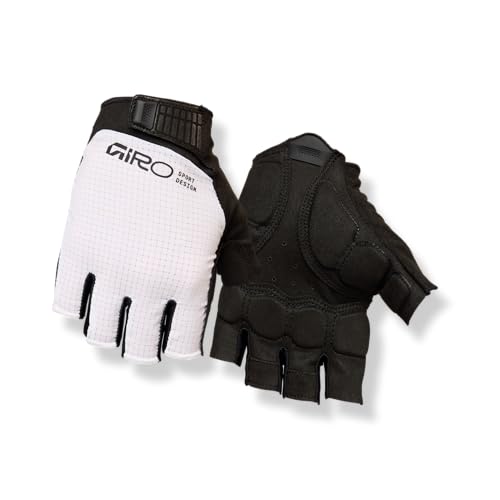
Giro Bravo II Gel
- Half finger with a gel-padded synthetic leather palm
- Microfibre wipe panel on the thumb
- Pull tabs at the fingers, which matters more than it sounds
- From a brand that has been designing bike gloves for decades
The Bravo is a long-running design and the reason to pick it over cheaper alternatives is the palm layout rather than the branding. Giro splits the gel into zones with channels between them, which is the construction detail described above and the one that separates a glove that helps from a glove that makes numbness worse. Half finger, so it is a summer and shoulder-season choice.

HTZPLOO Shock-Absorbing Half Finger Gloves
- Half finger with anti-slip palm print and a shock-absorbing pad
- Lightweight breathable back, aimed at warm weather
- Made in men's and women's sizing
- A sensible first pair to find out whether gloves help you
Under twenty dollars, which is the right amount to spend before you know whether padding suits your hands at all. Expect the palm material and the stitching to be a step below a brand-name glove, and expect to replace them sooner. As a way of testing whether the problem is your gloves or your bike fit, they are hard to argue with.
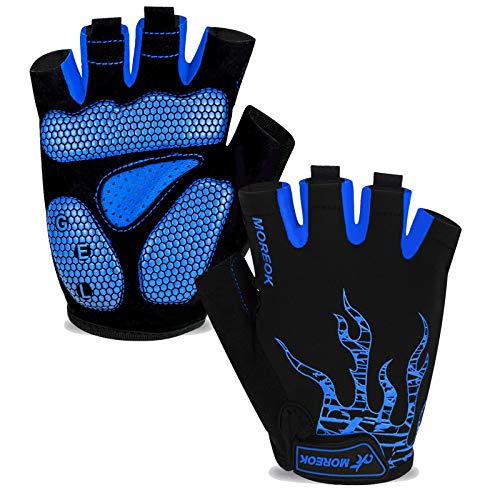
MOREOK 5 mm Gel Half Finger Gloves
- 5 mm gel padding, which is at the thick end of sensible
- Half finger, breathable back
- The cheapest way to add real cushioning
- Best on smooth grips and short rides
Buy these if vibration rather than numbness is your complaint, meaning your hands ache after rough tarmac rather than losing feeling. 5 mm is genuinely thick and you will notice it on the brake levers for the first few rides. If your symptom is dead fingers, go back to the fix order above before you go thicker.

MOREOK Thinsulate Winter Gloves
- 3M Thinsulate insulation with a waterproof and windproof outer
- Touchscreen-compatible thumb and index fingertip
- Long cuff that closes over the wrist
- Rated by the maker for deep cold rather than shoulder season
Windproofing is the specification that matters at ebike speeds and this pair has it, which puts it ahead of thicker gloves without a membrane. Treat the manufacturer's temperature rating as marketing rather than measurement; what you can rely on is the presence of a windproof layer and real insulation. Expect touchscreen use to be hit and miss, as it is on any thick glove.

ihuan Waterproof Winter Gloves
- Waterproof outer aimed at snow and cold rain
- Insulated, with a cuff that closes over a jacket sleeve
- Sold for cycling, driving and general cold-weather use
- A cheaper route to a windproof winter glove
General-purpose winter gloves rather than cycling-specific ones, which means the palm has no cycling padding and the cut is less shaped around a bar. In cold rain that trade is usually worth making, because staying dry matters more than palm design once the temperature drops. Pair them with a bike that is set up for the weather, as covered in riding an ebike in the rain.
| Glove | Type | Best for | Price |
|---|---|---|---|
| Giro Bravo II Gel | Half finger | Zoned padding done properly | $29.95 |
| HTZPLOO | Half finger | A first pair | $19.99 |
| MOREOK 5 mm Gel | Half finger | Vibration on rough roads | $13.59 |
| MOREOK Thinsulate | Winter | Cold and dry, windproof | $22.94 |
| ihuan Waterproof | Winter | Cold and wet | $19.99 |
Swipe sideways to see all columns →
How to choose
If you are shopping because your hands go numb, do not start here. Level the saddle, raise the bars, fit fatter or ergonomic grips, and make yourself move your hands. If the numbness survives all of that, buy a glove with zoned padding and channels, not the one with the biggest number on the box.
If you are shopping because you want protection, buy full finger. Palms and fingertips take the impact in almost every low-speed fall, and a synthetic leather palm is the difference between an inconvenience and a week of scabs. It pairs with the rest of the protective kit covered in our guide to bike helmets.
If you are shopping for winter, buy for wind first, water second and insulation third, and consider bar mitts if you are serious about riding through the cold. And if you ride year round, expect to own two pairs, because no single glove covers 90 F and 25 F.
Gloves sit in the same tier as grips and a saddle: cheap, high impact on comfort, and worth sorting before anything cosmetic. Our roundup of ebike parts and accessories puts them in order against everything else you might buy, and if you are still choosing the bike itself, best commuter electric bikes covers what to look for.