Training Wheels and Stability Aids for Adult Ebikes
Adult stabilisers solve a real problem for real riders. They also behave nothing like the ones on a child's bike, because a 65 lb powered bike leaning at 15 mph is a completely different load case.
On this page
There is a persistent idea online that adult training wheels are a joke product. They are not. Balance conditions, inner ear disorders, neurological conditions, riders recovering from a hip or knee replacement, riders who never learned as children, and older riders who have lost confidence after a fall all have a genuine need for a bike that does not fall over. The market for adult stabilisers exists because those riders exist.
What is fair to say is that the products are frequently oversold and frequently misapplied. A stabiliser kit designed around a 20 lb child bike doing 5 mph gets attached to a 65 lb electric bike doing 15 mph, and the physics of that are not remotely comparable. The bracket sees several times the force, the mounting hardware sees it repeatedly, and a lot of the cheap universal kits on the market are simply not built for it.
This guide covers when a stabiliser is the right answer, what to check before buying one, what it does to how the bike handles, and the alternatives that often suit the rider better than the thing they went looking for.
Who adult stabilisers are actually for
The clearest case is a rider whose balance is unreliable but whose legs, hands, and judgement are fine. Vestibular conditions, peripheral neuropathy, Parkinson's, multiple sclerosis, and the aftermath of a stroke all produce that pattern. So does the far more mundane situation of an older rider who came off once, was not badly hurt, and has not been able to get back on since. In every one of those cases the bike is doing something the rider can no longer reliably do, and doing it takes almost nothing away.
The second case is a rider learning as an adult. Here stabilisers are a transitional tool and should be treated as one, because they teach a steering habit that has to be unlearned later. Most cycling instructors now prefer the balance-bike method for adults too: drop the saddle, take the pedals off, and scoot until balance arrives, then refit the pedals. It is faster and it does not build the wrong reflex.
The third case, and the most common one in search traffic, is a rider who wants confidence at a stop rather than while moving. That is a different problem with a different solution. If the wobble happens when you put a foot down at a junction, the fix is a lower standover and a saddle you can sit on with both feet flat, which is exactly what step-through frames are for. Stabilisers are not the tool for that, and a good deal of disappointment comes from buying them to solve it.
Why an ebike is a different load case
A stabiliser wheel does nothing until the bike leans onto it. Once it takes the load, it is carrying a fraction of the total weight of bike plus rider, applied through a small steel arm bolted to a rear axle, at whatever speed you happen to be doing. Three numbers drive how hard that is.
Mass. A child's bike is around 20 lb and a child might be 50 lb. A typical Class 2 ebike is 50 to 75 lb and an adult rider might be 180 lb. That is roughly three and a half times the total mass, and the load on the arm scales with it directly. Our ebike weight guide covers where the weight sits and why it is so much higher than a conventional bike.
Speed. A child on stabilisers is doing 4 to 6 mph. An ebike on throttle does 20 mph without you asking. When a stabiliser wheel touches down at speed, it is not a gentle lean; it hits, and it has to survive both the vertical load and a side load from the tyre scrubbing across the tarmac as the bike continues forward while pivoting.
Surface. Kerbs, potholes, and driveway lips deliver shock loads several times the static load. On a child bike that bends an arm. On an adult ebike it snaps one, and it does so at the worst possible moment, which is while the bike is already leaning.
Put together, this is why the price spread on adult stabilisers is so wide. The cheap kits are child kits with longer arms. The expensive ones use thicker steel, wider mounting plates, and larger wheels, and they publish a weight rating. Paying more here is not a luxury purchase.
The five compatibility checks before you buy
1. Rear axle type
This is the check that eliminates most ebikes. Universal stabiliser kits clamp around a standard rear axle and are held by the axle nut. A rear hub motor axle is wider across the flats, is usually 12 to 14 mm rather than 10 mm, and is already carrying torque washers or a torque arm that must seat properly in the dropout. There is often no thread left for another bracket, and stacking a bracket on top of a torque washer defeats the washer, which is the part stopping the axle from spinning under motor torque.
A mid-drive ebike has a conventional rear axle and is far more likely to work. If you are still choosing a bike and stability aids are on the list, that alone is a reason to look at mid-drives; the difference is explained in mid-drive versus hub motor.
2. Wheel size and arm length
Stabiliser kits are sold for wheel size ranges because the arm has to hold the wheel at the right height relative to the ground. A kit sold for 24 to 26 inch wheels will not reach the ground properly on a 29 inch bike and will hold a 20 inch bike awkwardly high. Adjustable kits exist and are worth the premium precisely because the correct setting is found on the bike, not in the box.
3. Frame and dropout clearance
Look at the space behind the rear dropout with the wheel in. Fenders, rear racks, integrated lights, kickstands, and motor cables all compete for that area, and on many ebikes it is already full. A rear rack in particular usually bolts to the same dropout eyelet the stabiliser wants.
4. Total weight rating
Covered above. If the listing does not state a figure, treat the absence as an answer.
5. Ground clearance and the setup gap
Set correctly, both stabiliser wheels sit slightly above the ground when the bike is upright, so the bike still rolls on two wheels and only touches down when it starts to tip. Set them touching and the bike becomes a tricycle with a terrible track width, the rear tyre loses traction, and drive and braking both suffer. The correct gap is small, roughly a centimetre, and it needs rechecking after the first few rides as everything settles.
What changes once the bike cannot lean
This is the part almost no listing explains, and it matters more than the hardware. A bicycle turns by leaning. The lean angle balances the cornering force, which is why a bike going round a bend at 15 mph is tipped over noticeably. Stabilisers cap how far the bike can lean, which means at any meaningful speed the bike physically cannot corner the way it wants to.
What happens instead is that the bike leans until the outside stabiliser wheel touches, and then it stops leaning. From that moment the cornering force has to be resisted by the stabiliser rather than by the lean, and the bike wants to keep going straight. Push harder and the inside wheel unloads and the bike will skitter, tip on the outer arm, or in a bad case go over. This is the same behaviour that makes a tricycle feel unstable in a fast turn, but with a much narrower track, which makes it worse.
The practical consequence: a bike on stabilisers is a low-speed machine. Corner slowly, corner wide, and stay off cambered surfaces where the road slopes across your line, because a camber pre-loads one stabiliser and unloads the other before you have even turned. Descents deserve real caution, because gravity does not care about your assist setting and your brakes are hauling a lot of weight.
For this reason, if you are buying a bike to use with stabilisers, a Class 1 ebike is a better match than a throttle bike. Pedal assist gives you power that arrives in proportion to your pedalling rather than instantly at a thumb press, and a 20 mph assist cap is easier to stay well under. The differences are set out in ebike classes explained.
What stabilisers give you
- The bike stays upright at very low speed
- Cheap relative to buying a different machine
- Keep the bike you already own and like
- Removable if the need is temporary
What they take away
- Cornering has to be slow and wide
- Rear hub motor axles often will not accept them
- They add rattles, weight and one more thing to check
- They do not help at all with getting on and off
Stabilisers worth considering
These are the adult-rated kits currently available rather than child kits with longer arms. Before buying any of them, work through the five checks above, especially the axle. Nothing here fits a rear hub motor bike without inspection.
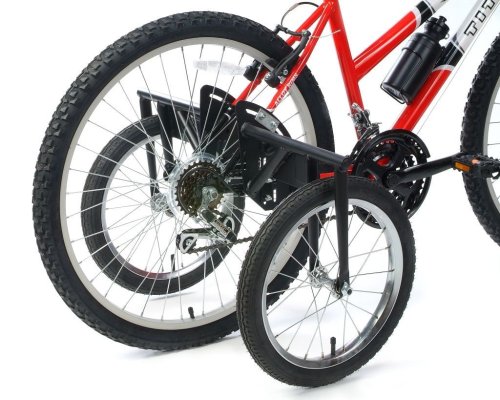
TITAN Heavy-Duty Adult Training Wheels
- Fits 24 to 27 inch bicycles
- Rated by the maker for 250 lb plus riders
- Steel stabiliser kit with mounting plates
- The long-established option in this category
The most substantial kit on this list and the one that most closely matches the loads an adult on a heavy bike will generate. It is also several times the price of the budget options, which tells you something about what the cheap ones are made of. If your rider is at the heavier end or the bike is at the heavier end, this is the tier to shop in.

MOLI DEE Adjustable Adult Bike Stabilisers
- Fits 24 to 29 inch wheels
- Adjustable height on the arms
- Heavy duty steel construction
- Sold as a pair with hardware
The adjustability is the reason to pick this over a fixed kit. Getting the ground gap right is fiddly and it changes as the tyres settle and the springs bed in, so arms you can move without shims save a lot of frustration. Confirm the published weight rating on the listing against your combined rider and bike weight before ordering.
EERONS Adult Bicycle Stabiliser Kit
- Listed for 20, 24, 26, 27.5 and 29 inch bikes
- Adult stabiliser design rather than a child kit
- Steel arms with adjustable mounting
- Useful if the bike is an unusual wheel size
The broadest wheel size coverage here, which makes it the default if your bike sits outside the usual 24 to 26 inch window. Small-wheel ebikes and folders are exactly the sort of bike that stabiliser makers ignore, so a kit that explicitly lists 20 inch is worth noting if you ride a folding ebike.

HUASION Adjustable Adult Training Wheels
- Fits 24 to 26 inch bikes
- Steel construction, sold as a pair
- Adjustable height
- Suited to low-speed, lighter use only
The entry point, and the one to be most careful with. At this price the arms are thinner and the wheels smaller, which is fine for a lighter rider on a lighter bike ridden at walking-plus pace on smooth ground, and marginal for a heavy ebike on rough tarmac. Buy it to try the concept, not as the permanent solution for a 70 lb bike.
The options compared
| Kit | Wheel sizes | Adjustable | Build | Best for |
|---|---|---|---|---|
| TITAN Heavy-Duty | 24 to 27 in | Yes | Heaviest | Heavier riders and bikes |
| MOLI DEE Adjustable | 24 to 29 in | Yes | Heavy duty steel | Larger-wheeled bikes |
| EERONS kit | 20 to 29 in | Yes | Steel | Unusual wheel sizes |
| HUASION Adjustable | 24 to 26 in | Yes | Lightest | Trying the concept cheaply |
Swipe sideways to see all columns →
Nothing in this table fits a rear hub motor axle as a given. Measure your axle across the flats and check what thread is left outside the dropout before you order any of them.
The alternatives that often suit better
An electric trike
If the rider needs stability permanently rather than temporarily, a trike is almost always the better machine. It is designed around three wheels: the rear track is wide enough to be meaningful, the frame carries the loads it expects, the braking is set up for the layout, and there is usually a proper cargo basket behind the seat. It is also stable when stationary, which stabilisers manage only approximately and which is the moment many riders actually fear. The trade is cost, storage space, and the fact that a trike has its own cornering rules. Start with our electric trike guide, and if you want a wider track and car-style stability, four wheel electric bikes covers the next category up.
A lower step-through frame
If the fear is really about mounting, dismounting, and putting a foot down at a stop, the answer is frame geometry, not extra wheels. A deep step-through lets you stand over the bike flat-footed and step off in any direction, and a saddle set low enough to reach the ground removes the wobble at junctions entirely. See comfort step-through ebikes.
A slower bike
Much of the risk in this whole discussion comes from speed. A Class 1 pedal assist bike, ridden in a low assist level, produces power gradually and tops out at 20 mph without a throttle to surprise you. Many riders who thought they needed stabilisers actually needed a bike that does not lurch when they touch the throttle. Our guide for senior riders goes through the same decision from the other direction.
A stationary or supported start
Worth mentioning because it costs nothing. A great deal of the instability people experience is confined to the first two seconds of moving off and the last two before stopping. Practising in an empty car park with a wall to push off, or with a helper holding the saddle, resolves it for a lot of riders in a couple of sessions. Try that before spending anything.
How to decide
- Permanent balance impairment, wants to keep riding: electric trike. It is the machine built for this, and the stabiliser is the compromise.
- Temporary need after injury or surgery, on a mid-drive bike: an adult stabiliser kit is reasonable. Buy the heavy tier, set the gap correctly, and ride slowly.
- Nervous at stops and junctions only: a step-through frame and a lower saddle. Stabilisers do not help here.
- Learning to ride as an adult: pedals off, saddle down, scoot. Faster than stabilisers and it teaches the right reflex.
- Rear hub motor bike, no mid-drive option: assume no kit fits until you have measured. Budget for a different machine rather than for a bracket.
One last point that is easy to miss. Stabilisers change how the bike behaves but not how heavy it is, and the moment most riders find genuinely difficult is holding a stationary 65 lb bike upright while getting a leg over it. No stabiliser fixes that. A lighter bike, a lower frame, or three wheels does.
If this article has pushed you toward a different machine rather than a bracket, the next reads are electric trikes for the stability-first option and electric bikes for seniors for the confidence-first one.