ROCKBROS Cycling Glasses
A $25 lens set covers most of what a $200 pair does for eye protection. Here is exactly where the gap is, and where it does not exist at all.
On this page
ROCKBROS is a Chinese cycling accessories brand that has become the default answer to the question of what to buy when you do not want to spend real money on sunglasses. It sells wrapped polycarbonate sports frames, usually with a set of interchangeable lenses, usually for somewhere between twenty and thirty dollars, and it sells a great many of them.
The interesting question is not whether these are as good as an Oakley. They are not. The interesting question is which parts of the job they do just as well, because the answer is most of it, and the parts they do worse are not the parts that protect your eyes.
Cycling glasses are protective equipment that happens to be tinted. At 20 mph a grit particle off a front tyre, a wasp or a rope of road spray arrives at your eye with enough energy to end the ride and possibly do permanent damage. A large polycarbonate lens marked UV400 in a wrapped frame stops all of that, and polycarbonate costs almost nothing. That is why the protective performance of the category converges at around $25 and the price spread above it is about refinement.
The honest framing, without the sneering
There is a tone that cycling media takes towards budget eyewear which is worth resisting, because it gets the argument backwards. The implied claim is that cheap glasses are a compromise on safety. They are not. A $25 polycarbonate lens and a $250 polycarbonate lens are made of the same class of material, and neither shatters. Both filter UV to the same specified limit. Both keep a bee out of your eye socket.
What is true is that the $250 lens is ground and moulded to a tighter optical tolerance, has better coatings, sits in a frame with better hinges, and holds its adjustment longer. Those things matter to riders who spend many hours a week looking through a lens. They matter much less to somebody riding three times a week for an hour.
And there is a scenario where the cheap pair is straightforwardly the better purchase. Glasses are consumables. They get sat on, dropped face down on tarmac, wiped with a jersey tail, and left on a car roof. A rider who owns one $250 pair and starts leaving it at home on gravel days has less eye protection than a rider who owns two $25 pairs and wears them everywhere. Protection you did not bring protects nothing. Our cycling sunglasses guide makes the same point about the whole category.
The two things you cannot compromise at any price
UV400
UV400 means the lens blocks wavelengths up to 400 nanometres, which covers UVA and UVB completely. It is not a premium feature. The UV blocking additive in polycarbonate costs almost nothing, which is exactly why every legitimate brand meets the spec and why its absence tells you something.
The mechanism that makes an unfiltered dark lens actively dangerous is worth understanding. Your pupil size is driven by visible light. Put a dark tint in front of your eye and the pupil opens. If that tint filters visible light but not ultraviolet, you have just widened the aperture on an unprotected sensor and increased total UV dose past what you would get with no glasses at all. This is the one genuine hazard in cheap eyewear, and it lives at the unbranded eight dollar end of the market, not at ROCKBROS.
Impact resistance
Polycarbonate is the same plastic family used in safety glasses and machine guards. Under impact it deforms and cracks rather than fragmenting, which is the entire reason it dominates sports eyewear. Acrylic and glass do not behave that way and have no business in front of your eye on a bike.
The formal reference point is ANSI Z87.1, the US occupational eye protection standard, which some cycling glasses are certified to and most are not. Treat certification as a nice signal rather than a requirement, because an uncertified polycarbonate lens is still enormously better than the alternatives. What you should refuse to buy is any lens whose material is not stated.
Where the extra money genuinely shows
Four places, in rough order of how much you will notice them.
Optical clarity at the lens edges
A curved lens is a lens with varying thickness and varying angle relative to your line of sight. Getting the centre right is easy. Keeping the periphery free of distortion, where the curve is steepest and your eye looks through the lens at an angle, is the hard part and it is where manufacturing tolerance shows up. On a budget lens you may notice slight warp when you turn your head quickly, or a sense that the road at the far edge of your vision is not quite where it should be.
Most riders adapt to this within a ride and stop noticing. Riders who are sensitive to it never stop noticing. There is no way to know which you are without trying a pair, which is another argument for starting cheap.
Coating durability
Two coatings matter: a hydrophilic anti fog layer on the inside surface, and a hard scratch resistant layer on the outside. Both exist on cheap lenses and both are thinner and softer than their premium equivalents. The practical consequence is that a budget anti fog coating starts losing effectiveness after a few months, particularly if the lens gets cleaned with anything abrasive.
Physical vents at the top edge of the lens are the durable half of the anti fog solution and they do not wear out, so weight those more heavily than a coating claim when comparing pairs.
Frame material and hinge life
Premium frames use grilamid or a similar high performance nylon that flexes thousands of times and returns to shape. Budget frames use cheaper polymers that take a set. The failure point is almost always the hinge, which develops play and then lets the arm splay, at which point the frame no longer grips your head and slides on sweat. This is the single most common way budget glasses die.
Lens swap mechanisms
Interchangeable systems rely on a snap fit or a small tab holding the lens under tension against the frame. On a good pair that tension is still there after two years. On a cheap pair it can slacken within a season, which shows up as a lens that rattles slightly on rough surfaces or pops loose when you take the glasses off carelessly. Swapping lenses less often makes it last longer, which is a slightly ironic outcome for a product sold on swapping.
How interchangeable sets actually work, and which tints matter
The interchangeable set is the reason budget eyewear punches above its price. A single premium lens at $200 gives you one tint that is excellent in one condition. A $25 set gives you three or more tints that are decent in three conditions, and the lens that suits the light beats the better lens that does not.
A typical set contains three useful lenses and sometimes two more that are mostly decoration:
- A dark grey or mirrored lens for bright sun. Grey is the neutral choice because it darkens everything equally and does not shift colour. A mirror coating on top reflects heat and light before it enters the lens.
- A yellow, orange or amber lens for flat light, overcast days and dusk. These cut blue wavelengths, which raises apparent contrast and makes surface texture on the road stand out. They look strange and they work.
- A clear lens for night, heavy rain and dark forest. This is the one riders skip and should not, because it is the lens that makes glasses a year round item rather than a summer one.
Polarisation is the option people misunderstand. It kills horizontally reflected glare, which is excellent over water and open tarmac in strong sun. It is also how you spot a wet patch, a diesel spill or black ice, so a polarised lens can remove the visual cue you most need on a descent, and it makes some bike computer and phone screens go dark at certain head angles. Our lens, tint and polarisation guide works through that trade off in full, and it is the piece to read before you decide which lens lives in the frame most of the time.
Four ROCKBROS pairs worth the money
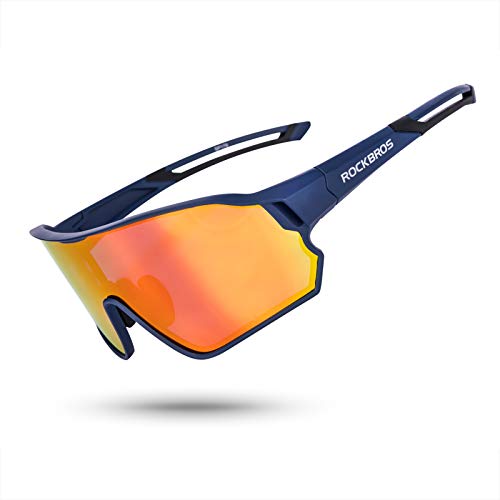
ROCKBROS Polarized Sports Sunglasses
- Polarised anti glare lens in a wrapped sports frame
- Thin blade arms designed to pass under helmet straps
- The default budget answer for bright open roads
- Check the listing states UV400 before ordering
This is the pair most people mean when they say ROCKBROS. It is a large wrapped polycarbonate lens in a light frame with rubber at the nose, for roughly the price of two coffees and a gel. The polarisation is a genuine benefit on bright open roads and a genuine drawback for spotting wet patches on a fast descent, so match it to where you ride rather than assuming polarised means better.

ROCKBROS 22g Photochromic Sunglasses
- Photochromic lens that darkens in UV and clears indoors
- Anti fog treatment on the inner surface
- Stated 22 g frame weight, light enough to forget
- No lens to carry, swap or lose mid ride
If you will not stop to change a lens, this is the honest answer, and getting a photochromic at this price is the single biggest value story in cycling eyewear. Understand the limits first: a photochromic is never as dark as a dedicated bright sun lens, never as clear as a true clear one, clears more slowly than it darkens, and responds to ultraviolet rather than to brightness, so it stays pale behind a car windscreen. Those are physical limits of the technology and they apply to expensive photochromics too.

ROCKBROS Photochromic with Myopia Insert Frame
- UV400 photochromic lens with anti fog treatment
- Removable inner frame that takes prescription lenses
- Goggle style coverage above and around the eye
- Cheapest route into prescription cycling eyewear
The insert route puts a small carrier frame behind the main lens, which your optician glazes to your prescription. It is not the best optical solution, because you are looking through two surfaces and the insert sits close enough to the eye to fog in some conditions. It is by a wide margin the cheapest, and for a rider who wants to try prescription eyewear before committing several hundred dollars to a direct glazed pair, it is the sensible first step. Our prescription guide lays out the three routes and what each really costs.

ROCKBROS Polarized Sports Sunglasses, Second Colourway
- Same wrapped frame and polarised lens in an alternate finish
- Cheap enough to keep in a commuting bag permanently
- A spare pair beats an expensive pair left at home
- Useful backup when the primary lens gets scratched
This exists as a recommendation for one reason: at this price the correct strategy is redundancy. Keep one pair permanently in the commuting bag or the car so that arriving without glasses stops being possible. It sounds like an upsell and it is not; it is the practical consequence of the argument this whole article makes, which is that the cheap pair you have with you protects you better than the expensive pair on the hall table.
The picks compared
| Pair | Lens type | Price | Prescription | Best for |
|---|---|---|---|---|
| Polarized Sports | Fixed polarised | $22.59 | No | Bright open roads, best all round value |
| 22g Photochromic | Photochromic | $29.99 | No | Dawn to dusk on one lens |
| Photochromic Myopia Frame | Photochromic | $26.59 | Insert frame | Riders who need correction |
| Polarized, second colourway | Fixed polarised | $22.59 | No | The spare that lives in your bag |
Swipe sideways to see all columns →
The row that changes people minds is the third. A prescription capable sports frame for roughly the price of a takeaway is a genuinely new option that did not exist a decade ago, and it removes the excuse for riding in a pair of road unsuitable everyday spectacles.
Making cheap lenses last
What ROCKBROS gets right
- Full protective performance: large polycarbonate lens, UV400 on the stated models, real coverage
- Interchangeable sets and photochromic lenses at prices premium brands cannot approach
- Cheap enough to own two, which changes how often you actually have eye protection with you
- Prescription insert options at a fraction of the cost of a direct glazed lens
- Thin blade arms and rubber nose grip, so the fundamentals of cycling frame design are there
Where the money would show
- Looser optical tolerance, so mild distortion at the far edges of the lens
- Softer coatings that lose anti fog effectiveness within months rather than years
- Cheaper frame polymer and hinges that develop play, which is the usual cause of death
- Lens retention that can slacken after a season of swapping
- Wide fit that does not suit narrow faces, with no adjustable temple length to fix it
Three habits roughly double the life of a budget pair. Never wipe a lens dry, because the grit sitting on it becomes an abrasive; rinse first, then use the bag they came in. Never clean the inside surface with anything but water and a soft cloth, because the anti fog layer is soft by design. And swap lenses over a soft surface with the frame supported, since most cracked budget lenses break during a swap rather than in a crash.
Storage matters too. Leaving glasses on a car dashboard cooks the coatings and can warp a thin frame enough to change how it grips. The case is not packaging.
How to choose in two minutes
- You want one cheap pair that covers most rides: the polarised set, unless you descend fast on roads where reading wet patches matters, in which case pick a non polarised tint.
- Your rides start before sunrise or end after dark: the photochromic, and accept a narrower range at both ends of the light scale.
- You wear glasses: the insert frame model, then read our prescription guide before you spend more.
- You have a narrow face and everything slides: ROCKBROS frames run wide with no adjustment. Read small face and low bridge fit first, because this is the one place a budget frame can genuinely fail you.
- You ride many hours a week and notice edge distortion: this is the honest point at which spending $80 to $150 stops being vanity.
The summary you should take away is not that expensive eyewear is a con. It is that the safety half of the product is solved at $25 and the comfort half is not, so buy according to how many hours you spend looking through the lens rather than according to how serious you want to look. If you ride an assisted bike, ebike classes explained is worth reading first, because a Class 3 machine holds 28 mph and every argument about wind, grit and tearing gets more urgent at that speed. From here, our main sunglasses guide covers the whole market, and if you are still building out the bike, parts and accessories is the next stop.